Price and Inflation Expectations Survey
User Guide
Learn how to use the Price and Inflation Expectations Survey (PIES) data explorer to understand firms’ inflation expectations, how those expectations change over time, and how they compare with observed inflation outcomes.
The PIES dashboard, developed by the Federal Reserve Bank of Philadelphia, provides an interactive way to explore how firms view prices and inflation. The firm data come from PIES, a quarterly survey of businesses in the Third Federal Reserve District. We ask firms how much they expect their own prices, own employee compensation, and U.S. consumer prices to change over the next year, as well as how much their own prices have changed over the past year. We summarize these responses using 10 percent trimmed means and medians and present the means in the data explorer. They are also available to download.
Using the Data Explorer
You can use the charts in the data explorer to understand firms’ inflation expectations, how those expectations change over time, and how they compare with observed inflation outcomes.
Explore Expectations Tab
Use the Explore Expectations tab to compare expectations across firm types and price types. The chart displays firms’ one-year-ahead forecasts for changes in prices, wages, and U.S. inflation.
Users can toggle between viewing the data in one of two breakdowns:
- plot all three price expectation types (own firm prices, own firm compensation, and U.S. inflation) and select firm type (all firms, manufacturing firms, or nonmanufacturing firms) to see how expectations for all price types vary for a specific firm type; or
- plot all three firm types and select a price type to see how expectations for all firm types vary for a specific price type.
Data points for these expectations are plotted one year ahead to match the time horizon of the forecast. For example, expected price changes collected and published in 2025 Q2 will be plotted in 2026 Q2 because the expected price change is for the period from 2025 Q2 to 2026 Q2.
Compare Firm Prices with CPI Tab
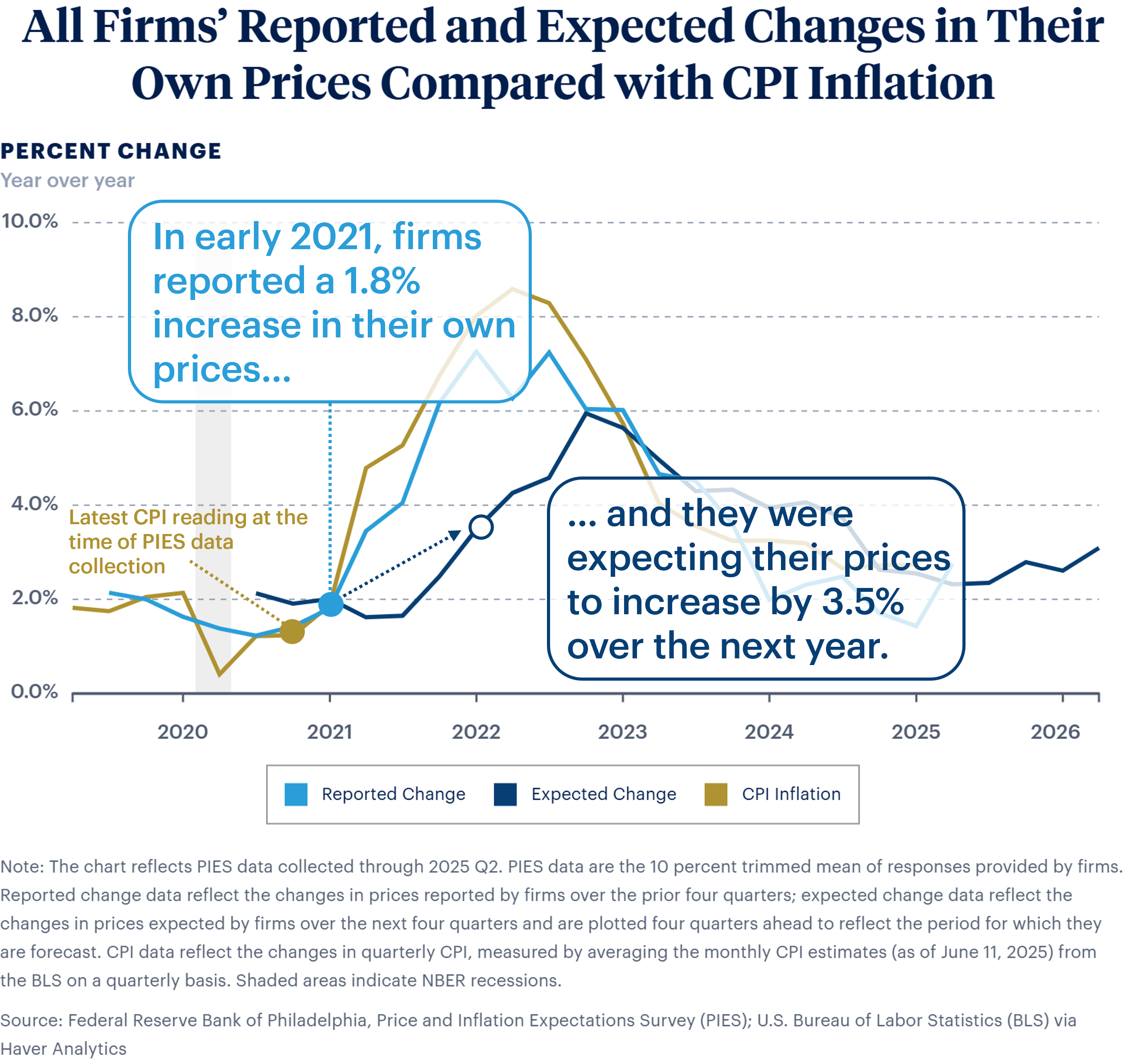
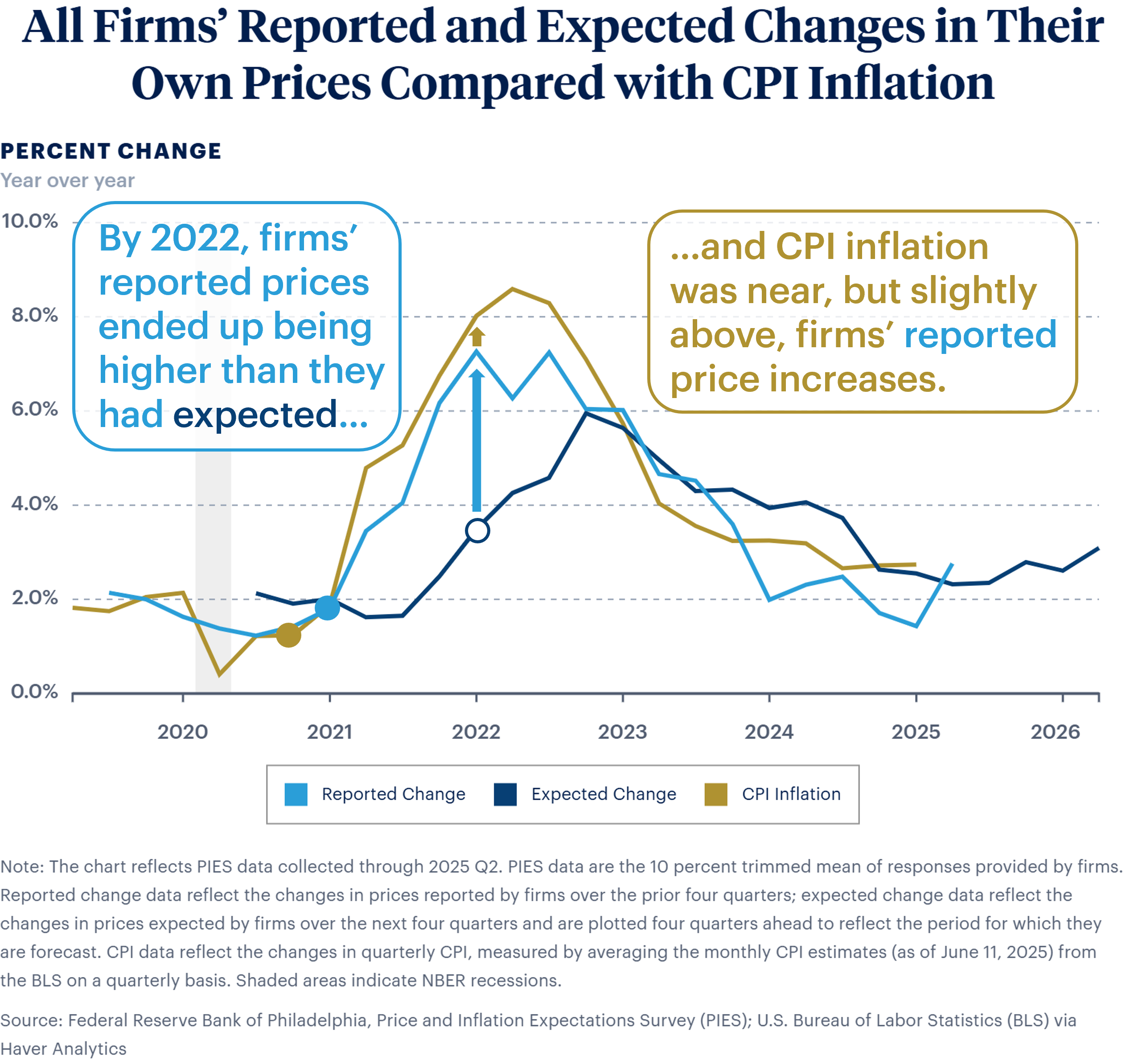
Use the Compare Firm Prices with CPI tab to see how firm expectations and reported own price changes align with actual inflation outcomes, and see how all three measures change over time.
Users can filter the chart to show results by firm type and highlight the following three data series:
- firms’ reported own price changes over the past year;
- firms’ expectations for their own price changes over the next year; and
- actual U.S. inflation as measured by the U.S. Bureau of Labor Statistics’ CPI.1
Each data point is plotted in the final quarter of the four-quarter period it represents: Expected price changes are plotted one year ahead, while reported changes and the CPI reflect the changes over the past four quarters. You can filter the chart to display results for all firms, manufacturing firms, or nonmanufacturing firms.
The images below show an annotated example from 2021 Q1, when firms provided expectations for 2022 Q1.
Using the Data
You can also download PIES data. The downloadable Excel file includes all historical quarterly PIES data and is updated with each quarterly PIES release.2 The file contains the means and medians of responses from all firms each quarter, with breakdowns included for manufacturing and nonmanufacturing firms, for each PIES question.
With these data, you can track business price and inflation expectations over time, compare reported price changes with future expectations, and examine how firms’ forecasts relate to broader inflation measures like the CPI.
Before working with the data, users should review the PIES Definitions page or the first sheet of the PIES data file. Both resources explain what each variable means and clarify whether the data apply to manufacturing, nonmanufacturing, or all firms.
Other Things to Keep in Mind
Keep the following points in mind when working with the data:
- Most variables (e.g., piesownprices, piescompensation, piesusinflation, piesusinflation10yr) reflect what firms expect to happen, not what has already occurred. Firms’ reported actual price changes are captured by piesownpricespast.3
- PIES data represent percent changes over a one-year period, either looking ahead for the forecast variables, or looking back for the reported actual price change. For example, a value of “4.0” for piesownprices represents a mean expected increase of 4 percent in prices for firms’ own goods over the next year. Similarly, a value of “3.5” for piesownpricespast indicates that the mean reported increase in prices for firms’ own goods was 3.5 percent over the past year. Piesusinflation10yr, on the other hand, is expressed as the average annual percent change over a 10-year period.
- PIES values reflect aggregated responses from a sample of manufacturing and nonmanufacturing firms in the Philadelphia Fed’s District. These results are not individual firm-level data, real-time market indicators, or nationally representative figures. They offer useful insight into regional business sentiment but may not necessarily reflect conditions across the entire U.S. economy.
We caution against overinterpreting individual data points or short-term changes. These averages reflect subjective perceptions and are best used to identify directional trends, not to make precise forecasts. PIES offers additional insights in conjunction with other sources, such as CPI or forecasts from the Survey of Professional Forecasters (SPF).
Year-over-year CPI values are calculated from the quarterly averages of monthly inflation estimates from the Bureau of Labor Statistics.
Note: In the downloadable data file, data are stored by the quarter in which the PIES data were collected. For example, for the row of 2025 Q4 data, the PIES forecast variables reflect expected changes four quarters ahead, from 2025 Q4 to 2026 Q4, and the reported own price change variable reflects the change over the past four quarters, from 2024 Q4 to 2025 Q4.
Data collection for this variable began in 2019 Q3.