Price and Inflation Expectations Survey
2026 Q1 Report
View a PDF version of this report
Note: Survey responses were collected from February 9 to February 19.
Firms’ Expectations of Price Growth Are Mixed Relative to Last Quarter
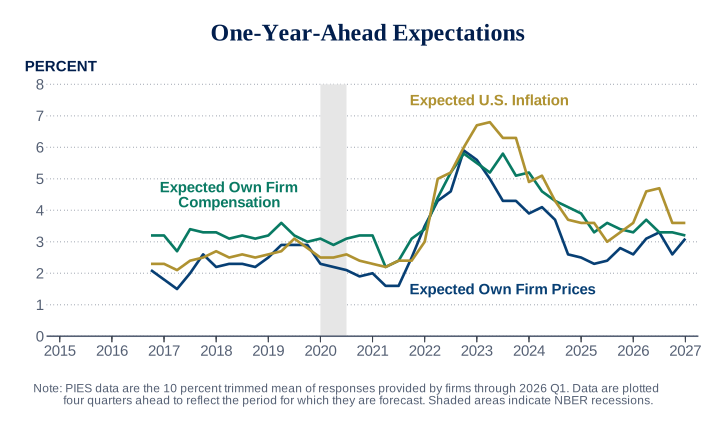
Compared with the fourth quarter of 2025, Third District firms reported in the first quarter of 2026 that expected increases for their own prices over the next four quarters moved up while their expectations for U.S. inflation held steady. Their expectations for compensation were little changed and remain near pre-pandemic levels. Firms reported a slightly smaller increase in their own prices over the past year compared with last quarter.
Firms Expect Larger Rise in Own Prices and Mostly Steady Growth in Compensation Relative to Last Quarter
For the first quarter of 2026 through the first quarter of 2027, the firms’ mean forecast for their own prices was for an increase of 3.1 percent, up from 2.6 percent last quarter. Firms expected compensation costs per employee to rise 3.2 percent over the same period, similar to the 3.3 percent they expected last quarter. The mean forecast for U.S. inflation was unchanged at 3.6 percent.
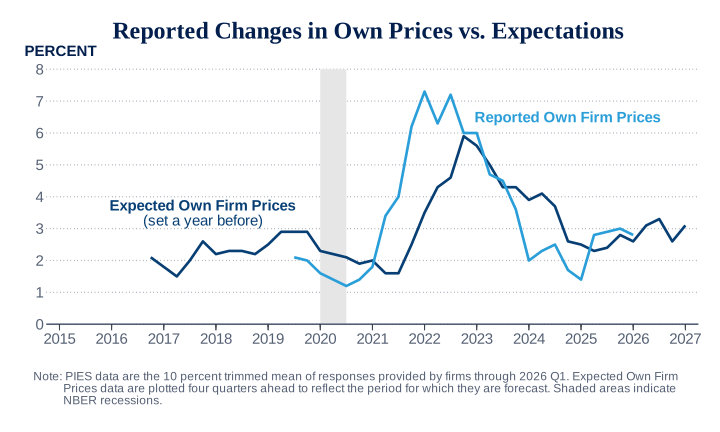
Firms Expect Larger Price Increases Compared with Their Current Price Growth
Looking back over the past year (the first quarter of 2025 to the first quarter of 2026), firms reported that the prices they received for their own goods and services rose 2.8 percent, down slightly from the 3.0 percent they reported last quarter but lower than the 3.1 percent growth they expect over the next four quarters.
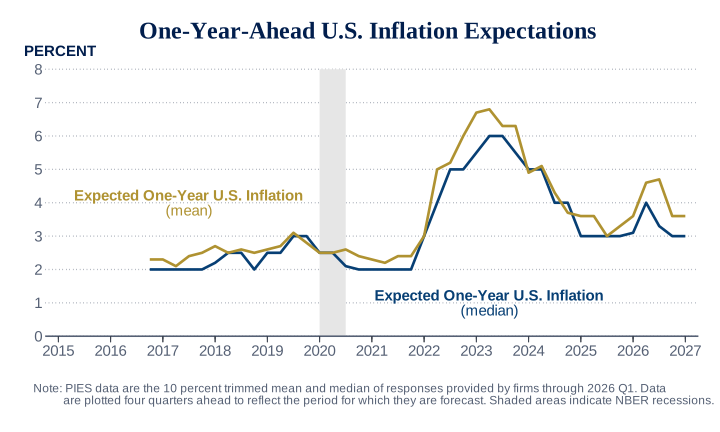
Firms’ U.S. Inflation Expectations Hold Steady Relative to Last Quarter
Firms’ median expectation for U.S. inflation was unchanged at 3.0 percent, holding at its lowest reading in more than a year. The mean expectation was also unchanged at 3.6 percent.
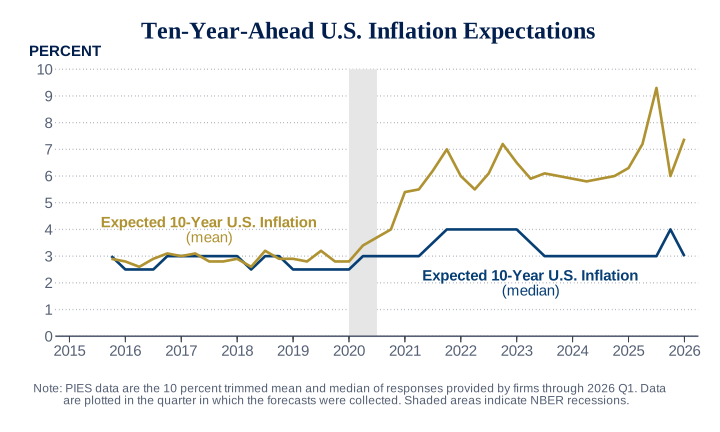
Long-Term Median Inflation Expectations Tick Down
For the longer run, firms’ median expectation of the average annual price increase that U.S. consumers will experience over the next 10 years declined to 3.0 percent from 4.0 percent. This has been the firms’ median expectation in 10 of the past 11 quarters. The mean expectation rose to 7.4 percent from 6.0 percent, after declining last quarter.
Price and Inflation Expectations Survey
| Firm Type | Current 2026 Q1 (%) | Previous 2025 Q4 (%) | |
|---|---|---|---|
|
Reported Change in Own Firm Prices Prices the respondent's firm received (for its own goods and services sold) over the past four quarters |
All | 2.8 | 3.0 |
| Manufacturing | 4.0 | 2.9 | |
| Nonmanufacturing | 2.0 | 3.0 | |
|
Expected Change in Own Firm Prices Prices the respondent's firm will receive (for its own goods and services sold) over the next four quarters |
All | 3.1 | 2.6 |
| Manufacturing | 3.7 | 2.9 | |
| Nonmanufacturing | 2.5 | 2.4 | |
|
Expected Change in Own Compensation Compensation the respondent's firm will pay per employee (for wages and benefits) over the next four quarters |
All | 3.2 | 3.3 |
| Manufacturing | 3.7 | 3.2 | |
| Nonmanufacturing | 2.8 | 3.3 | |
|
Expected U.S. Inflation Prices U.S. consumers will pay for goods and services over the next four quarters |
All (median) | 3.0 | 3.0 |
| All | 3.6 | 3.6 | |
| Manufacturing | 3.8 | 3.2 | |
| Nonmanufacturing | 3.5 | 4.1 | |
|
Expected Long-Run U.S. Inflation Prices U.S. consumers will pay for goods and services over the next 10 years (2026–2035) |
All (median) | 3.0 | 4.0 |
| All | 7.4 | 6.0 | |
| Manufacturing | 6.2 | 5.4 | |
| Nonmanufacturing | 8.3 | 6.6 | |
| Notes: Results reflect data received through February 19, 2026. The numbers in the table represent the trimmed means of individual firm forecasts (percent changes) unless noted otherwise. For Long-Run U.S. Inflation forecasts, firms provided a 10-year annual-average change. The previous quarter’s results reflect forecasts made in 2025 Q4 for 2026 Q4. | |||
To see how reported and expected firm prices compare with U.S. CPI over time, see the PIES data explorer.
For more information on how PIES data compare with U.S. CPI as well as with other inflation forecasts, see Introducing PIES.