


Before the 1980s, remote work was rare in the United States. Not anymore. In the 2010s, the number of people working from home (WFH), either completely or in part, saw a steady rise, fueled by improvements in communication technologies, shifting occupational composition, and changing workplace norms. This trend accelerated sharply during the COVID-19 pandemic. Although remote work has moderated since then, it continues to be a significant component of the U.S. workforce.
The shift toward flexible work arrangements has noteworthy geographic and economic effects. WFH helps employees reduce commuting expenses and broaden their job prospects. Additionally, by disentangling residence and workplace, WFH enables people to move to regions that are more cost-effective or offer better amenities. These factors can improve the overall quality of life.
At the same time, WFH may reduce welfare through its impact on housing costs. First, WFH increases demand for homes that can double as office space, pushing up housing demand broadly.1 Second, it encourages households to move to areas with lower prices or better amenities, raising demand in those locations. Without a corresponding expansion in the housing supply, this heightened demand is likely to drive up prices in the receiving location while putting downward pressure on prices in the sending location. (The total net effect on affordability depends on how elastic prices are in each location.)
The effect of flexible work arrangements on individual welfare depends on how these factors interact. Importantly, this impact is not uniform across worker demographics or regions because the ability to work remotely and the attractiveness of local amenities vary widely.
The Spike in WFH
In the United States, WFH was virtually unheard of prior to the 1980s. In 1965, full workdays completed at home accounted for less than 1 percent of all compensated workdays (excluding domestic workers).2 This percentage gradually rose over the following decades, reaching around 7 percent by 2019. At the height of the COVID-19 pandemic in 2021, it had surged to nearly 60 percent. It has declined since then, stabilizing at approximately 28 percent as of 2023.
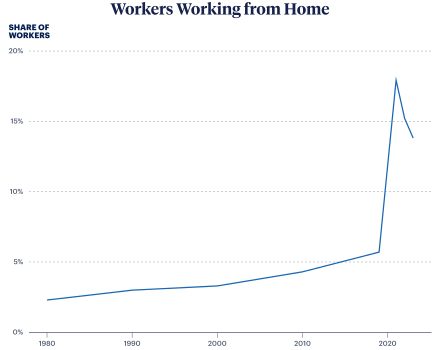
The proportion of employees who primarily work from home for most of their week has also risen. In 2005, when the U.S. Census Bureau fully launched the American Community Survey (ACS), around 3.6 percent of U.S. workers reported WFH for most of their workweek. This share had risen to 4.3 percent by 2010 and increased further to 5.7 percent by 2019. During 2021, the peak year of the pandemic, the share surged to 17.9 percent. In 2022, as the pandemic waned, it declined to 15.2 percent. By 2023, it had settled at 13.8 percent (Figure 1).3
Figure 1
See Drivers of WFH for more info
WFH Improves Welfare … Unevenly
Remote work enhances people's well-being by reducing commuting expenses in terms of both time and money. Data from the ACS indicate that public transit commuters spend an average of 89.2 minutes per day on a round-trip commute. Financially, this costs commuters approximately $600 annually for bus users and $976 for rapid transit riders. Car commuters spend an average of 50.8 minutes daily on a round-trip commute, with yearly costs totaling $2,040. The median household income was $80,610 in 2023, so these expenses represent 1.2 percent of total household income for rapid transit users and 2.5 percent for car commuters. If both partners in a household commute, these shares double to 2.4 percent and 5.0 percent, respectively.
Remote work also improves employment opportunities by removing geographic barriers, which allows individuals to apply for and accept jobs regardless of the job's physical location. This flexibility enables workers to access positions in regions with higher wages, better career prospects, and industries that are otherwise concentrated in distant cities.
The benefits of WFH, however, are not uniformly experienced across all demographics. There is a significant disparity in access to WFH based on socioeconomic factors. Professionals with a higher skill level, a higher income, and an advanced education have a greater likelihood of engaging in remote work. Statistics from the U.S. Bureau of Labor Statistics (BLS) indicate that individuals with a bachelor's or higher degree had a telework rate of 38.4 percent in the first quarter of 2024.4 Those with some college education or an associate's degree had a rate of 18.3 percent, and those with only a high school diploma had a rate of 8.5 percent. Individuals without a high school diploma had the lowest telework rate at 3.5 percent.5
The likelihood of WFH is also influenced by the nature of the employing industry. Occupations that require substantial physical effort — such as jobs in natural resources, construction, maintenance, production, transportation, and material moving — naturally exhibit a low telework rate. By contrast, industries that rely heavily on knowledge work and digital tasks are much more amenable to remote work. For example, the December 2024 Current Population Survey found that the finance and insurance sectors had the highest telework rate at 61.5 percent, while the accommodation and food services sectors had the lowest at just 3.8 percent. This highlights how occupational and industry characteristics play a critical role in determining access to flexible work arrangements.
Notably, employees in the information sector are often highly skilled, highly educated, and well paid. These characteristics influence not only their ability to adapt to remote work but also their career mobility, bargaining power, and access to high-quality jobs. As a result, they are more likely to take advantage of flexible work arrangements, relocate to areas with better amenities, and drive changes in local labor and housing markets.
WFH Shifts Housing Demand from One Location to Another
As more people work from home, housing demand may increase because these workers need larger living spaces to accommodate their home offices. Households can meet this need by either renovating their existing homes or relocating to larger residences with additional amenities, both of which contribute to greater housing demand and, consequently, higher house prices. According to one recent study, remote households spend over 7 percent more on housing than comparable nonremote households within the same commuting zone.6 This higher expenditure is driven by larger dwellings with more rooms and by the higher cost per room.
However, not all housing markets have been affected equally. WFH has increased housing demand in suburban and other low-density areas while reducing demand in some large cities and dense urban centers. Some researchers have studied these migration patterns indirectly by analyzing the rent-bid curve (also called a bid-rent curve), which describes how much households or firms are willing to pay for land (or rent) at different locations relative to a city's center. These researchers have found that the rent-bid curve flattened during and shortly after the pandemic within metropolitan statistical areas, suggesting that housing demand in city centers declined relative to the suburbs.7
Other researchers have used microdata and survey data to explicitly map this migration pattern. Researchers using data from the U.S. Postal Service and Zillow have found that households, businesses, and real estate demand shifted from dense central business districts to lower-density suburban zip codes in major U.S. cities.8 Other researchers report similar results using microdata from a national moving company.9 Similarly, migration outflows from urban neighborhoods during 2020 have been documented using credit bureau data10 and mortgage application records.11
Highly educated workers, who are better equipped for remote work, have been the primary drivers of migration to suburban areas.12 The relocation of these higher-income individuals has contributed to rising housing prices in regions that also accommodate lower-income residents. However, this migration generally flows from areas with low housing supply elasticity to those with higher elasticity, which helps mitigate some of the upward pressure on housing prices.
Because of these migration patterns, regions have fared differently depending on the quality of their local amenities and the elasticity of their housing supply. States that are more affordable and offer attractive amenities — such as a pleasant climate, access to nature, and opportunities for outdoor recreation — have experienced greater net in-migration. This influx of residents stimulates local economies through increased demand for goods, services, and housing, but it also puts pressure on infrastructure, schools, and the local health-care system. Regions with a more elastic housing market are better able to accommodate this growth without an extreme spike in the cost of housing, whereas areas with a limited housing supply may see a sharper increase in prices, potentially exacerbating affordability challenges for long-term residents.
According to our research, which utilizes mailing addresses reported in credit bureau files, migration patterns in the United States between 2020 and 2022 varied significantly across states and cities (Table 1). During this period, the states with the highest net in-migration were Florida, Texas, North Carolina, Arizona, and South Carolina, reflecting their combination of relatively affordable housing, a favorable climate, and attractive amenities. Conversely, the states with the highest net out-migration were California, New York, Illinois, and Massachusetts, which are characterized by a higher cost of living, dense urban centers, and, in some cases, a more restrictive housing market. Cities exhibited similar patterns: Dallas, Tampa, Phoenix, and Austin recorded the largest net in-migration, drawing residents with their cheaper housing, plentiful jobs, and superior quality of life. By contrast, major metropolitan hubs such as New York City, Los Angeles, San Francisco, and Chicago experienced the largest net out-migration, suggesting that high costs, long commutes, and dense living conditions may have pushed residents to seek more affordable or spacious alternatives. These shifts highlight how both economic and lifestyle factors are reshaping the distribution of the population in the United States, with implications for local labor markets, housing demand, and regional development.13
Table 1
Migration Patterns in the United States
States and metropolitan statistical areas (MSAs) with the highest and lowest net in-migration rates, per 1,000, 1Q2020–1Q2022
| State/MSA | Inflow | Outflow | Net Inflow |
|---|---|---|---|
| Top Five States | |||
| Florida | 1264.8 | 816.1 | 448.7 |
| Texas | 1063.9 | 756.2 | 307.7 |
| North Carolina | 559.7 | 414.6 | 145.1 |
| Arizona | 439.8 | 319.2 | 120.6 |
| South Carolina | 328.4 | 215.0 | 113.4 |
| Bottom Five States | |||
| California | 815.4 | 1409.0 | -593.6 |
| New York | 519.1 | 1034.7 | -515.6 |
| Illinois | 313.7 | 524.6 | -210.9 |
| Massachusetts | 216.6 | 306.9 | -90.3 |
| Maryland | 276.6 | 325.5 | -48.8 |
| Top Five MSAs | |||
| Dallas–Fort Worth–Arlington, TX | 433.2 | 317.9 | 115.3 |
| Tampa–St. Petersburg–Clearwater, FL | 273.7 | 189.8 | 83.9 |
| Phoenix–Mesa–Scottsdale, AZ | 323.7 | 248.0 | 75.6 |
| Austin–Round Rock, TX | 216.6 | 151.8 | 64.8 |
| North Port–Sarasota–Bradenton, FL | 104.6 | 50.7 | 53.9 |
| Bottom Five MSAs | |||
| New York–Newark–Jersey City, NY–NJ–PA | 443.8 | 961.0 | -517.2 |
| Los Angeles–Long Beach–Anaheim, CA | 444.5 | 740.4 | -295.9 |
| San Francisco–Oakland–Hayward, CA | 237.2 | 415.7 | -178.5 |
| Chicago–Naperville–Elgin, IL–IN–WI | 238.2 | 409.8 | -171.6 |
| Washington–Arlington–Alexandria, DC–VA–MD–WV | 324.4 | 437.7 | -113.3 |
Drivers of WFH
According to research conducted by Stanford University professor of economics Nicholas Bloom and his coauthors, the rise of WFH is largely driven by three major forces.14 First, rapid advances in information and communication technology have fundamentally changed how work can be carried out. High-speed internet, secure cloud-based systems, and a wide range of digital collaboration platforms — such as Microsoft Teams, Slack, and Zoom — allow employees to communicate, share documents, and coordinate tasks almost as seamlessly as they would in a physical office. These tools not only improve efficiency but also reduce the friction traditionally associated with remote work.
Second, social norms surrounding WFH have shifted dramatically. What was once viewed as a special perk, an accommodation, or even a sign that an employee lacked commitment has gradually become a widely accepted and often preferred mode of work. Employers have become more comfortable assessing performance based on output rather than physical presence, while workers increasingly value flexibility, autonomy, and an improved work–life balance.
Third, the COVID-19 pandemic served as a powerful catalyst. Virtually overnight, organizations were forced to adopt remote operations at scale, which accelerated the normalization of virtual collaboration. This period demonstrated that many tasks could be performed remotely without major loss of productivity, prompting firms to reassess their long-run workforce strategies. As a result, WFH has become an enduring feature of the modern labor market rather than a temporary response to a crisis.
Conclusion
Recent studies indicate that WFH has particularly increased demand for smaller, less-populated regions that offer attractive amenities, and benefited highly skilled, highly educated, and high-income employees. These workers are often better equipped to take advantage of flexible work arrangements and can relocate to areas that provide greater space, a lower cost of living, and a better quality of life. By contrast, lower-skilled, less-educated, and lower-income workers are less likely to have access to remote work opportunities, which can place them in direct competition for housing with higher-income, highly educated workers relocating to the same areas. Large cities with high rents and a dense population have also experienced a relative decline in both population growth and housing affordability.
WFH's impact on individuals goes beyond the costs of commuting and housing. There is also its impact on labor productivity, innovation, and the accumulation of human capital. These factors influence long-term career trajectories, earnings potential, and economic mobility. To date, however, there is no consensus about the overall effects of WFH, which is why we need more research into how flexible work arrangements reshape labor markets, regional economies, and individual well-being.
References
Barrero, Jose Maria, Nicholas Bloom, and Steven Davis. "The Evolution of Work from Home," Journal of Economic Perspectives, 37:4 (2023), pp. 23–50, https://doi.org/10.1257/jep.37.4.23.
Bick, Alexander, Adam Blandin, and Karel Mertens. "Work from Home Before and After the COVID-19 Outbreak," American Economic Journal: Macroeconomics, 15:4 (2023), pp. 1–39, https://doi.org/10.1257/mac.20210061.
Bloom, Nicholas, James Liang, John Roberts, and Zhichun Jenny Ying. "Does Working from Home Work? Evidence from a Chinese Experiment," Quarterly Journal of Economics, 130:1 (2015), pp. 165–218, https://doi.org/10.1093/qje/qju032.
Bloom, Nicholas, and Arne Künn-Nelen. "Working from Home Is Polarizing," Labour Economics (forthcoming).
Brynjolfsson, Erik, John J. Horton, Adam Ozimek, et al. "COVID-19 and Remote Work: An Early Look at U.S. Data," National Bureau of Economic Research Working Paper 27344 (2020), https://doi.org/10.3386/w27344.
Buckman, Shelby R., Jose Maria Barrero, Nicholas Bloom, and Steven J. Davis. "Measuring Work from Home," National Bureau of Economic Research Working Paper 33508 (2025), https://doi.org/10.3386/w33508.
Fisher, Kimberly, Jonathan Gershuny, Sarah M. Flood, Joan Garcia Roman, and Sandra L. Hofferth. American Heritage Time Use Study Extract Builder: Version 1.2 [data set]. Minneapolis, MN: IPUMS, 2018, https://doi.org/10.18128/D061.V1.2.
Flood, Sarah M., Liana C. Sayer, Daniel Backman, and Annie Chen. American Time Use Survey Data Extract Builder: Version 3.2 [data set]. College Park, MD: University of Maryland and Minneapolis, MN: IPUMS, 2025, https://doi.org/10.18128/D060.V3.3.
Gupta, Arpit, Vrinda Mittal, Jonas Peeters, and Stijn Van Nieuwerburgh. "Flattening the Curve: Pandemic-Induced Revaluation of Urban Real Estate," National Bureau of Economic Research Working Paper 28675 (2021), https://doi.org/10.3386/w28675.
Hansen, Stephen, Peter John Lambert, Nicholas Bloom, et al. "Remote Work Across Jobs, Companies and Space," National Bureau of Economic Research Working Paper 31007 (2023), https://doi.org/10.3386/w31007.
Haslag, Peter, and Daniel Weagley. "From L.A. to Boise: How Migration Has Changed During the COVID-19 Pandemic," Journal of Financial and Quantitative Analysis, 59:5 (2024), pp. 2068–2098, https://doi.org/10.1017/S002210902300073X.
Li, Wenli, and Yichen Su. "The Great Reshuffle: Remote Work and Residential Sorting," European Economic Review, 182 (2026), 105195, https://doi.org/10.1016/j.euroecorev.2025.105195.
Liu, Sitian, and Yichen Su. "The Impact of the COVID-19 Pandemic on the Demand for Density: Evidence from the U.S. Housing Market," Economics Letters, 207 (2021), 110010, https://doi.org/10.1016/j.econlet.2021.110010.
Meeker, Rebecca, and Nuno Mota. "COVID-19's Impact on Housing Demand in High-Density Areas—Evidence from Purchase Mortgage Applications," Fannie Mae White Paper (2021), https://www.fanniemae.com/media/38866/display.
Ramani, Arjun, and Nicholas Bloom. "The Donut Effect of COVID-19 on Cities," National Bureau of Economic Research Working Paper 28876 (2021), https://doi.org/10.3386/w28876.
Stanton, Christopher, and Pratyush Tiwari. "Housing Consumption and the Cost of Remote Work," National Bureau of Economic Research Working Paper 28483 (2021), https://doi.org/10.3386/w28483.
U.S. Bureau of Labor Statistics. "Telework Rates Increased Over the Year at All Levels of Educational Attainment, First Quarter 2024," TED: The Economics Daily, April 2, 2025, https://www.bls.gov/opub/ted/2025/telework-rates-increased-over-the-year-at-all-levels-of-educational-attainment-first-quarter-2024.htm.
Whitaker, Stephan D. "Did the COVID-19 Pandemic Cause an Urban Exodus?" Cleveland Fed District Data Brief (2021), https://doi.org/10.26509/frbc-ddb-20210205.
- The views expressed in this article are not necessarily those of the Federal Reserve Bank of Philadelphia or the Federal Reserve System.
- Households can either renovate existing houses to add office space or move to houses with larger spaces. In both cases, housing demand rises broadly.
- See Fisher et al. (2018) and Flood et al. (2025).
- See Barrero et al. (2023), Bick et al. (2023), Brynjolfsson et al. (2020), Buckman et al. (2025), and Hansen et al. (2023).
- U.S. Bureau of Labor Statistics (2025).
- The BLS defines the telework rate as the number of people who teleworked or worked at home for pay as a percentage of those who were employed and at work during the survey reference week.
- Stanton and Tiwari (2021).
- Liu and Su (2021) and Gupta et al. (2021).
- Ramani and Bloom (2021). Although this shift in demand could reflect a demand for more space, it could also reflect less distaste for longer commutes in a post-COVID era.
- Haslag and Weagley (2024).
- Whitaker (2021) and Li and Su (2026).
- Meeker and Mota (2021).
- See Li and Su (2026).
- But note that many of the receivers had been growing faster than the senders for years before the surge in WFH.
- See Bloom et al. (2015) and Bloom and Künn-Nelen (forthcoming).