


Banks' lending to nonbank financial institutions (NBFIs) shows a clear pattern of specialization — that is, many banks specialize in lending to only a few types of NBFIs. Although specialization fosters strong relationships and information advantages, it also raises concentration risk. For example, broker-dealers and money-market mutual funds, which are central to U.S. Treasury market intermediation and short-term funding, can come under pressure during episodes of market volatility such as the "dash for cash" in March 2020. Meanwhile, mortgage originators and servicers are most vulnerable when real estate markets weaken or when refinancing activity collapses, as seen during the housing downturn of 2008–2009, and again in parts of 2022–2023 when rising interest rates slowed new loan issuance.
Diversification spreads risk but may reduce close relationships with borrowers. So, does this specialization pose a systemic risk to the banking industry? That depends on which banks specialize their NBFI lending. In this, the second of two articles on this subject, we examine which bank characteristics correlate with NBFI lending. Doing so helps us ascertain the systemic risk posed by specialized lending to NBFIs.
For both articles, we analyzed confidential loan-level data from the FR Y-14Q regulatory reports, which provide detailed information on the lending activities of medium and large U.S. banks. Because these institutions account for most of the credit extended to NBFIs, our sample captures the essential features of this market. We classify NBFIs into 11 types based on industry codes, ranging from broker-dealers and insurance companies to private-credit funds and mortgage firms.1 We then measure how concentrated each bank's NBFI portfolio is across these types. This allows us to quantify the degree of specialization for each bank and to compare banks across the financial system.
Specialization and Bank Characteristics
Theoretical and empirical work suggests that the degree of specialization reflects a bank's features, including its size, capitalization, funding model, and geographic reach. These characteristics shape both the bank's ability to bear risk and its comparative advantage in accumulating information about borrowers or sectors. For example, larger, geographically diversified banks might be better positioned to withstand shocks to a particular type of NBFI, whereas smaller or capital-constrained banks may depend more on sector-specific expertise. Because specialization can influence both financial stability and the allocation of credit, we need to identify which of these characteristics comove with specialization. (These comovements reflect simple correlations; it is not evidence of causation.) The full extent to which banks are exposed to NBFIs might not be completely transparent in the data because we focus on direct loan commitments between banks and NBFIs.
NBFI Lending and Specialization
To understand the systemic risk posed by specialization, we need to look at both the amount of money a bank is lending to its Top NBFI type and the total amount of money it's lending to all NBFIs relative to total lending. When we do this, we observe a (somewhat nonlinear) negative relationship between NBFI specialization and the ratio of NBFI loans to total loans (Figure 1).2 This implies that for banks in which the NBFI loan portfolio is more specialized, the size of NBFI lending relative to total lending is smaller. For example, banks with a ratio of 5 percent have an excess specialization well above 35 percent, but banks with a ratio of 10 percent have an excess specialization just above 20 percent. However, this relationship is nonlinear: For banks with a ratio of 18 percent (which is the high end of the spectrum of ratios in our sample), excess specialization is back up to almost 30 percent.
Figure 1
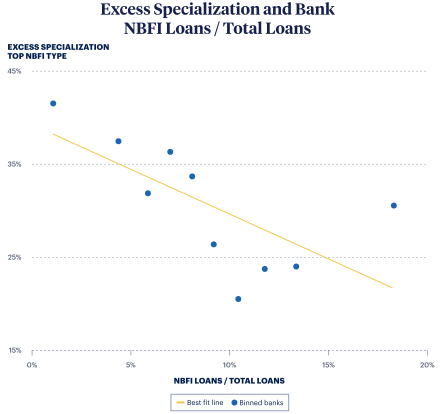
Note: "Excess specialization Top NBFI type" refers to excess specialization for the NBFI type with the largest share of lending within each bank portfolio. Banks are sorted by NBFI Loans / Total Loans and placed into 10 bins (Cattaneo et al. [2024]). Each dot corresponds to a bin-specialization measure pair after controlling for time and NBFI-type fixed effects.
Size and Specialization
Bank size is one of the most robust predictors of specialization. Within our sample of relatively large banks, bank size is negatively correlated with excess specialization (Figure 2) and NBFI lending concentration (Figure 3).3 This is consistent with other research that has looked at other areas of bank diversification and bank size. Large banks tend to maintain more diversified loan portfolios, both across industries and geographically. Economies of scale, access to broader funding markets, and the need to comply with complex regulatory frameworks encourage large banks to spread their exposure rather than concentrating on a single type of borrower. Smaller banks, by contrast, often benefit from specialization. Their limited scale and local focus create incentives to develop deep knowledge of only certain borrowers or industries. Relatively small banks often specialize in lending to specific types of NBFIs, such as mortgage companies, leasing firms, and insurance brokers. In doing so, they can use their accumulated expertise to manage the associated credit risk.
Because larger banks also tend to be geographically diversified (that is, with a presence across many geographic markets), there is likely a positive correlation between banks that are geographically diverse and banks that lend to diverse NBFIs.
Figure 2
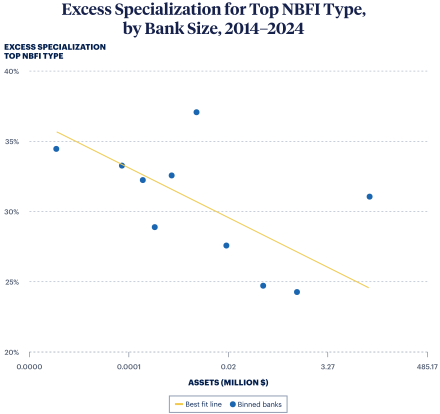
Note: "Excess specialization Top NBFI" refers to excess specialization for the NBFI type with the largest share of lending within each bank portfolio. Banks are sorted by assets and placed into 10 bins (Cattaneo et al. [2024]). Each dot corresponds to a bin-specialization measure pair after controlling for time and NBFI-type fixed effects.
Figure 3
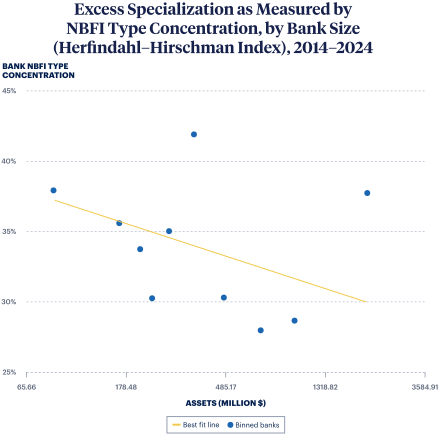
Note: "Bank NBFI type concentration" refers to the sum of the lending share to each NBFI type squared (like a Herfindahl–Hirschman Index [HHI]). Banks are sorted by assets and placed into 10 bins (Cattaneo et al. [2024]). Each dot corresponds to a bin-specialization measure pair after controlling for time and NBFI-type fixed effects.
Specialization and Asset-Side Concentration
A bank's mix of assets influences how specialized it can afford to be. We measure the extent of asset-side concentration by calculating total loans, including loans to NBFIs, as a share of total assets (the loan-to-asset ratio). We find that those banks with a larger loan-to-asset ratio also lend to a more diversified array of NBFIs (Figure 4). This evidence suggests a nuanced relationship: Banks with a more diversified total asset portfolio — for example, banks with significant securities holdings or noninterest income — tend to exhibit greater specialization within their loan books. Perhaps diversification across asset classes allows a bank to accept more concentration risk from NBFI lending. Or maybe some banks choose a more "liquid" balance sheet so they can concentrate their NBFI lending. This link between asset diversification and diversification within the portfolio of loans to NBFIs suggests that balance-sheet diversification and NBFI loan specialization are complementary strategies.
Figure 4
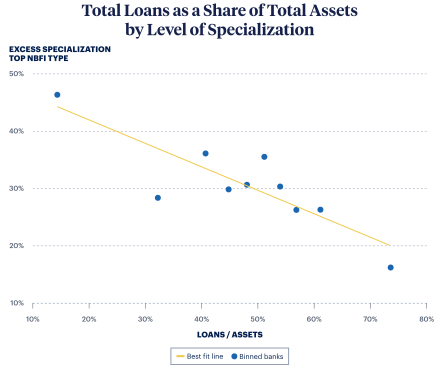
Note: Banks are sorted according to total loans as a share of total assets and placed into 10 bins using binscatter (Cattaneo et al. [2024]). Each dot corresponds to a bin-specialization measure pair after controlling for time and NBFI-type fixed effects.
Specialization and Asset Returns
Empirical work shows that specialized banks typically have a lower average return on loans or assets (ROA) than diversified banks.4 We find a negative correlation between asset returns and NBFI specialization (Figure 5). There are a few reasons why specialization and returns might be negatively correlated. Perhaps specialized banks target narrow markets in which loan demand is less elastic or it costs more to monitor borrowers. Or maybe specialized banks willingly forgo higher potential returns in exchange for stability within a known niche. Or perhaps specialization signals that the bank is not well run and thus not able to access new activities and high returns. In the case of NBFI lending, specialization might also lead to longer-term relationships or tighter covenants with borrowers, which would limit bank profits but make it less likely that a borrower will default.
Figure 5
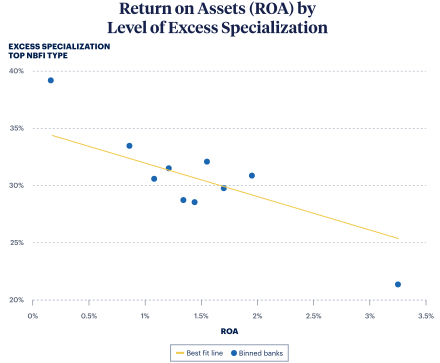
Note: Banks are sorted according to ROA and placed into 10 bins using binscatter (Cattaneo et al. [2024]). Each dot corresponds to a bin-specialization measure pair after controlling for time and NBFI-type fixed effects.
Bank Capital and Specialization
Although specialization is negatively correlated with size and asset structure, it is positively correlated with bank capital. Well-capitalized banks might be better able to bear concentrated risk and are less constrained by regulatory capital requirements. In contrast, thinly capitalized banks face tighter limits on exposure to any one sector. Alternatively, more diversified banks can choose to pay out more retained earnings and accumulate less capital. Our data suggest that, in the context of NBFI lending, bank capital and NBFI lending are negatively related (Figure 6).5
Figure 6
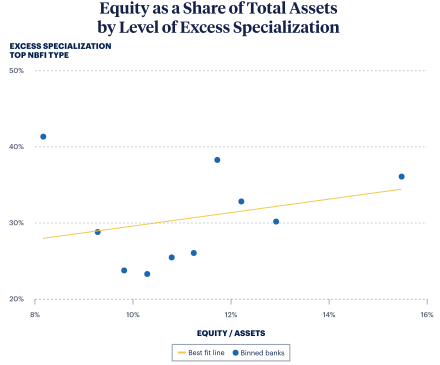
Note: Banks are sorted according to equity as a share of total assets and placed into 10 bins using binscatter (Cattaneo et al. [2024]). Each dot corresponds to a bin-specialization measure pair after controlling for time and NBFI-type fixed effects.
These correlations suggest that specialization is not necessarily risky. Specialization often coincides with characteristics — such as strong capitalization and diversified funding — that mitigate systemic risk. Banks that specialize in lending to NBFIs tend to be smaller and better capitalized, implying that a shock to a specific type of NBFI is less likely to propagate widely through the banking sector.
From a systemic perspective, specialization could even enhance efficiency. Concentration in lending may allow banks to allocate credit more effectively by leveraging industry expertise, improving screening, and reducing asymmetric information. Diversification, although stabilizing for an individual bank, can introduce collective vulnerabilities if all large institutions are exposed to the same macroeconomic factors. Conversely, a heterogeneous mix of specialized and diversified banks should create a more resilient financial system, with risk distributed across both industry and institution types.
Conclusion
Specialization varies across institutions: Some banks remain broadly diversified across types of NBFIs, while others focus on a single segment. Certain features, such as size and capitalization, correlate strongly with the degree of specialization. Among the largest banks, specialization seems to be moderate. In contrast, smaller banks, which are less likely to pose a systemic risk, tend to specialize in their NBFI lending.
That is, although specialization has risen, it's most notable in smaller, well-capitalized institutions. This pattern mitigates (but does not eliminate) concerns about systemic risk. It also underscores the importance of understanding who specializes in what, and how the boundary between banks and NBFIs continues to shift.
In short, banks' lending to NBFIs shows a clear pattern of specialization. Although specialization fosters strong relationships and information advantages, it also raises concentration risk. Diversification spreads risk but may reduce close relationships with borrowers. The specific correlations between bank characteristics and types of NBFIs suggest that the systemic risk associated with lending to NBFIs is not as high as it might otherwise be. But policymakers and regulators still need to understand which banks specialize because the balance between diversification and specialization has important implications for bank performance, funding stability, and financial stability.
References
Acharya, Viral V., Iftekhar Hasan, and Anthony Saunders. "Should Banks Be Diversified? Evidence from Individual Bank Loan Portfolios," Journal of Business, 79:3 (2006), pp. 1355–1412, https://doi.org/10.1086/500679.
Blickle, Kristian, Cecilia Parlatore, and Anthony Saunders. "Specialization in Banking," National Bureau of Economic Research Working Paper 31077 (2023), https://doi.org/10.3386/w31077.
Board of Governors of the Federal Reserve System. Financial Stability Report (April 2025), https://www.federalreserve.gov/publications/files/financial-stability-report-20250425.pdf.
Cattaneo, Matias D., Richard K. Crump, Max H. Farrell, and Yingjie Feng. "On Binscatter," American Economic Review, 114:5 (2024), pp. 1488–1514, https://doi.org/10.1257/aer.20221576.
DiSalvo, James. "Banking Trends: Why Banks Finance Their Nonbank Competitors," Federal Reserve Bank of Philadelphia Economic Insights (third quarter 2024), pp. 15–21, https://www.philadelphiafed.org/the-economy/banking-and-financial-markets/banking-trends-why-banks-finance-their-nonbank-competitors.
- The views expressed in this article are not necessarily those of the Federal Reserve Bank of Philadelphia or the Federal Reserve System.
- We borrow these classifications from DiSalvo (2024), and we follow the naming convention in Board of Governors (2025).
- The mean of the ratio of NBFI drawn loans to total loans is on average 17.9 percent; the median is 19.4 percent.
- Asset values are plotted using a base-10 logarithmic scale.
- See, for example, Acharya et al. (2006) and Blickle et al. (2023).
- In our sample, we found a -0.41 correlation between bank size and capital ratios from 2014 to 2024, so we cannot dismiss the possibility that bank size is the driving factor of the observed correlation between bank capital and NBFI specialization. However, a simple panel regression of bank-level NBFI-type concentration (Figure 3) on bank assets and bank equity ratios with bank and time fixed effects results in both coefficients' being significant.