


Over the past two decades, nonbank financial institutions (NBFIs) have grown dramatically, reshaping the U.S. financial landscape. Unlike traditional banks, NBFIs — which include broker-dealers, real estate lenders, insurance companies, investment funds, and other financial intermediaries — cannot issue insured deposits. They are often described as part of the "shadow banking system." This term can be misleading, however, since most of these institutions are not part of the banking sector.
Today, NBFIs manage well over half of all financial assets in the United States and play an increasingly significant role in the financial system. They have become major players in the mortgage market, in both origination and servicing, and have captured a sizable share of commercial and industrial lending. NBFIs also provide key funding and liquidity in securities markets, supporting the trading and financing of U.S. Treasuries and other assets.1Simultaneously, the banking sector's exposure to NBFIs has increased, too. Banks have long served as a vital source of funding for NBFIs, but bank lending activity to this sector has accelerated in recent years, primarily through the provision of credit lines. These arrangements enable NBFIs to access liquidity when market conditions become tighter. By enabling NBFIs to draw funds when needed, these credit lines provide flexibility but also create off-balance-sheet exposure for the banks that supply them.2 As of the last quarter of 2024, total commitments to NBFIs comprise over 11.3 percent of large banks' assets, and drawn loans have grown (by 8.9 percentage points since 2014) to comprise 17.9 percent of large banks' total loans.3 This exposure affects both the day-to-day market infrastructure and the transmission of monetary policy.
How risky is bank lending to NBFIs? That depends on the extent of the exposure, who's doing the borrowing, and, most significantly, banks' specialization in this lending. A specialized bank lends predominantly to an individual type of NBFI, whereas a diversified bank spreads its lending more evenly across many types. Specialization may yield efficiency and information advantages, but it can also magnify the bank's vulnerability to shocks within that sector. Diversification, in turn, may reduce idiosyncratic risk — but at the cost of weaker monitoring or lower profitability. Specialization is therefore central to our understanding of systemic risk.
In this, the first of two articles on this subject, we analyze data to quantify how specialized the banking sector has become. In the next article, we'll examine which kinds of banks are most likely to specialize in lending to NBFIs. Together, the two articles help us anticipate the systemic risk posed by this lending.
Costs and Benefits of Specialization
Specialization improves efficiency and strengthens relationships with borrowers, but it also leaves the lender more exposed to the risks of the particular markets it serves. These trade-offs help explain why some banks focus on a handful of NBFI types while others maintain a broader reach.
Benefits of Specialization
When a bank specializes, it focuses its lending activity on a small number of NBFIs — such as broker-dealers, private-credit funds, and money-market mutual funds — rather than spreading credit across all types. This concentration allows the bank to develop deeper knowledge of and operate more efficiently within a specific sector. The bank also learns the nuances of the balance sheets, funding models, and risk profiles of its target NBFIs. For example, banks that specialize in providing liquidity to money-market mutual funds and broker-dealers must develop expertise in collateral valuation, intraday liquidity management, and regulatory capital treatment of off-balance-sheet exposures. This familiarity translates into stronger and more informed relationships. Eventually, the bank becomes expert at evaluating the creditworthiness of its NBFI borrowers and anticipating their funding needs, especially in a volatile market.
This specialized knowledge also offers spillover benefits. Information gathered through close relationships with NBFIs can be used in other credit markets or in related financial activities, such as market making, asset servicing, or risk management. In this way, specialization strengthens a bank's position not only within a single lending niche but across its broader network of financial activities.
Moreover, specialization helps banks tailor loan terms more effectively. Familiarity with an industry's cash flow cycles and collateral practices enables banks to design credit lines that better align with borrower operations. In competitive lending markets, this ability to customize credit products becomes a valuable differentiator. Specialized banks often attract and retain high-quality borrowers precisely because they understand the sector's business model and can structure financing accordingly. One notable example: Banks that have a large presence in real estate lending have market power in the upstream credit market for nonbank (fintech and nonfintech) real estate lenders, which in turn reduces mortgage market competition, allowing these banks to keep profit margins high.4
Costs of Specialization
However, specialization also makes a bank more vulnerable. By concentrating its exposure among a small number of NBFI types, a specialized bank becomes more sensitive to downturns or disruptions affecting those sectors. If one type of NBFI, such as private-credit funds or fintech lenders, faces funding stress or market losses, the banks most exposed to that type will be disproportionately affected.
This is the principal cost of specialization. Whereas a diversified bank can offset its losses in one segment with earnings elsewhere, a specialized bank is subject to the fluctuations of its chosen niche. Adverse developments specific to an NBFI type, such as a sudden drop in lending by fintechs or liquidity strains in money-market mutual funds, can undermine the stability and profitability of specialized lenders. For example, recent bankruptcies at firms financed almost exclusively by private credit have raised concerns about the financial stability of banks exposed to this type of NBFI.5 And during the COVID-19 panic of March 2020, providers of short-term credit to money-market mutual funds faced heavy withdrawals and collateral calls.
Balancing Information and Vulnerability
In summary, specialization offers banks the possibility of more accurate information, more efficient credit assessment, and stronger borrower relationships, but at the cost of greater exposure to industry-specific shocks. The challenge for each institution is to balance these competing forces — that is, to leverage its informational advantage while maintaining sufficient capital, liquidity, and diversification elsewhere on the balance sheet to withstand sectoral downturns.
These trade-offs underpin much of the empirical evidence discussed in the following sections. Banks differ not only in how much they lend to NBFIs but also in which types of NBFIs they choose to serve and the degree of their concentration. Understanding the costs and benefits of specialization helps explain why this diversity of strategies persists and why specialization, when well managed, can coexist with financial stability.
Evidence of Specialization
Which strategy dominates the market: diversification or specialization? This matters not only for bank behavior but also for financial stability. NBFIs have become integral to modern credit markets, and banks are their principal source of liquidity. This is why we need to understand how banks distribute their lending across different types of NBFIs.
Figure 1
Data Source: Federal Reserve Capital Assessments and Stress Testing (FR Y-14Q) Reports
Note: "Other financial vehicles" includes private credit, business development companies (BDCs), and other
entities; "SPV" refers to special purpose vehicles; "CLO" to collateralized loan obligations; "ABS" to
asset-backed securities.
Measuring Specialization
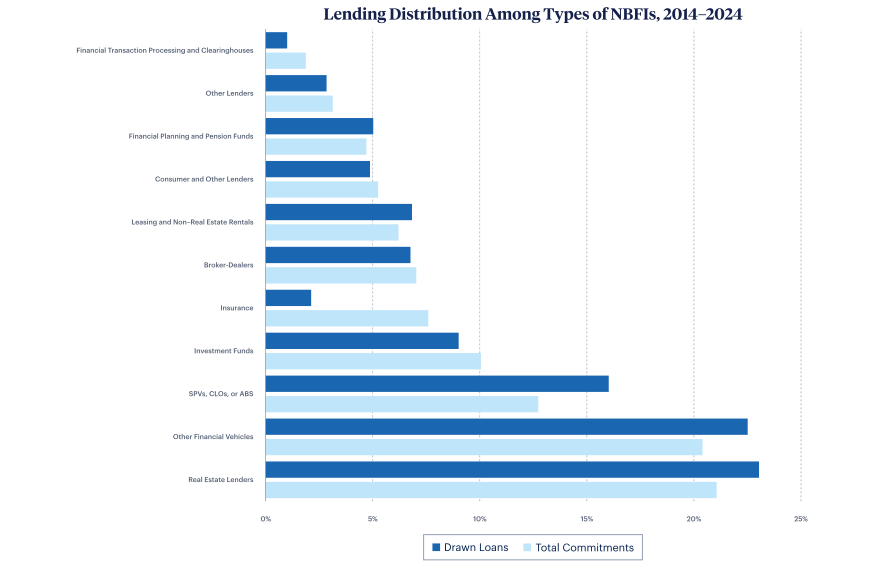
Using industry codes, we classify NBFIs into 11 types, including insurance companies, broker-dealers, private credit funds, money-market mutual funds, business development companies (BDCs), and several others that collectively account for the bulk of nonbank credit intermediation (Figure 1).6
To quantify how much of each bank's total NBFI lending goes to each type of NBFI, we use confidential supervisory data from the FR Y-14Q regulatory filings, which contain detailed, loan-level information on U.S. bank exposure to each type of borrower. From this data, we construct both simple and refined measures of specialization at both the bank level and the industry level. Specifically, we measure the total amount of credit a bank is committed to extend as well as the total credit it has already disbursed (that is, drawn loans). We find that the NBFI type with the largest average industry share based on total commitments is real estate lenders and lessors.7 The second largest is other financial vehicles (OFV), which includes private credit funds as well as BDCs.8
Our Benchmark: A Simple Measure of Specialization
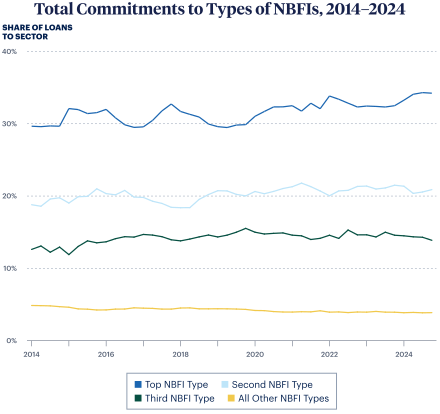
We first compute a straightforward benchmark: the share of each bank's NBFI lending that goes to each NBFI borrower type.9 To study specialization patterns, we rank each bank's exposure for each type of NBFI using total commitments. We then rank the types of NBFIs according to this share. We call the NBFI type with the largest share the Top NBFI type, the second largest the Second NBFI type, and the third largest the Third NBFI type. Finally, we compute the average shares across banks for the Top, Second, and Third NBFI types as well as for all other NBFI types.
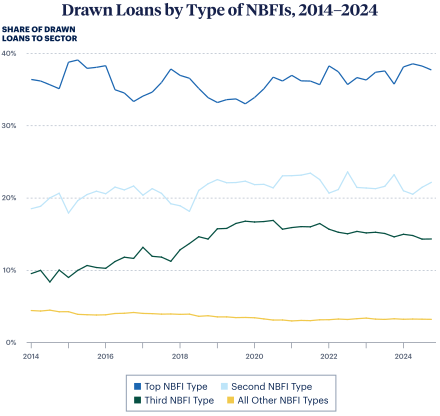
On average, total commitments extended to a bank's Top NBFI type accounts for more than 30 percent of its total NBFI commitments. In other words, a typical bank directs about one-third of its NBFI lending to a single type of NBFI. The fraction of lending going to the Second and Third NBFI types declines rapidly; the average for all other NBFI types represents only 4 percent on average (Figure 2). A similar pattern arises when looking at total drawn loans, but in this case the average for the Top NBFI type is close to 40 percent (Figure 3).
Figure 2
Data Source: Federal Reserve Capital Assessments and Stress Testing (FR Y-14Q) Reports
and
authors' calculations
Note: Averages are total commitments weighted.
Figure 3
Data Source: Federal Reserve Capital Assessments and Stress Testing (FR Y-14Q) Reports
and authors' calculations
Note: Averages are total commitments weighted.
This simple measure indicates an increase in specialization since the onset of the COVID-19 pandemic. The average share of total commitments going to the Top NBFI type was 30.6 percent between 2014 and 2019, but it increased to 33 percent between 2021 and 2024. The change is also significant for the average share of drawn loans going to the Top NBFI type: It was 35.7 percent between 2014 and 2019 and 37.1 percent between 2021 and 2024.
Although this evidence provides a sense of loan portfolio concentration, it might be an inadequate measure of specialization. NBFI types vary in size and importance in the economy and in lending markets. For example, insurance companies encompass a much larger market than BDCs. To find out which banks specialize more than others, and perhaps why, we develop a more refined measure of specialization.
A More Refined Measure: Excess Specialization
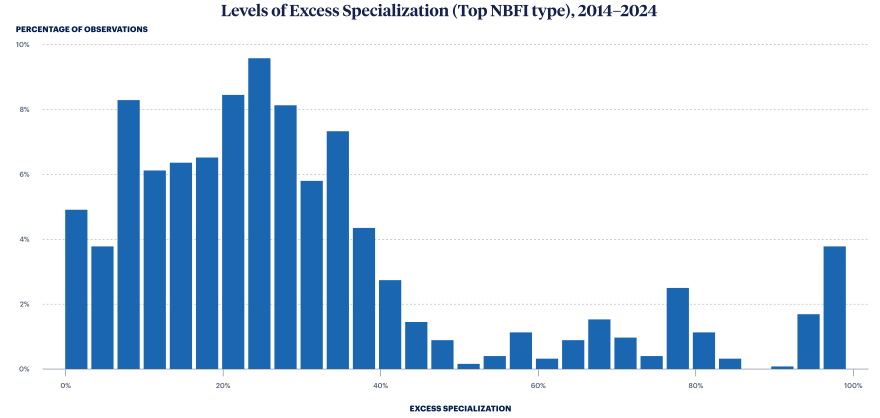
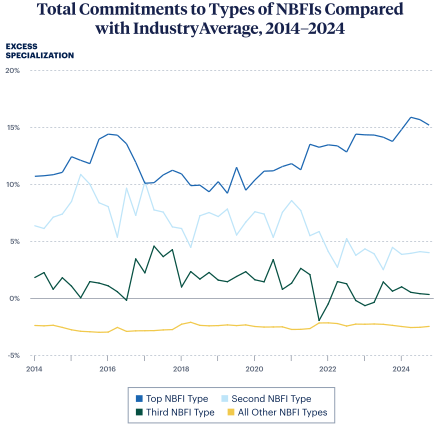
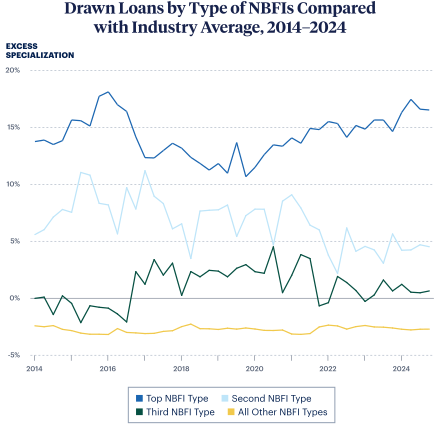
To dig deeper, we measure how much each bank's lending pattern deviates from the industry's average across NBFI types. For each NBFI type, we calculate the share of total NBFI lending it received from all banks in the sample. Then, for each bank and NBFI type, we compute the difference between the bank's lending share and the systemwide share. For example, if on average 20 percent of bank NBFI lending goes to the real estate category, but a particular bank directs 50 percent of NBFI lending to real estate, that bank would have excess specialization of 50 percent minus 20 percent, or 30 percent. This difference captures the degree to which a bank's focus on any NBFI type exceeds or falls below what is typical in the industry, and it gives us the data we need to find correlations between individual banks and specialization. A positive measure of excess specialization indicates that the bank is lending more than the industry to that NBFI type.10
Figure 4
Data Source: Federal Reserve Capital Assessments and Stress Testing (FR Y-14Q) Reports and
authors' calculations
Note: Each observation is a bank-quarter pair.
Our results show that each bank's excess specialization to its Top NBFI type was, on average, 12.5 percentage points above the industry average for that NBFI type.11 There is substantial heterogeneity in excess specialization for the Top NBFI type: At some banks, the market share is in line with the industry average (that is, excess specialization is close to 0). But at other banks, excess specialization for the Top NBFI type can reach above 80 percentage points (Figure 4). We also find that the average excess specialization is not driven by a few outliers. Specialization is even higher when we examine drawn loans. Although the banking system remains diversified across the major types of NBFIs, individual banks still exhibit clear preferences and areas of focus.
For both total commitments and drawn loans, there has been a noticeable increase in excess specialization since 2020 for the Top NBFI type. Excess specialization in total commitments for the Top NBFI type was 11.3 percent between 2014 and 2019; it increased to 13.9 percent between 2021 and 2024 (Figure 5). For drawn loans, it was 13.8 percent between 2014 and 2019 and 15.3 percent between 2021 and 2024 (Figure 6). This is evidence that industrywide specialization has become more pronounced. This trend aligns with the broader expansion of nonbank finance, and particularly the rapid growth of private credit funds, BDCs, and other investment vehicles that now play an outsized role in corporate and leveraged lending. As these institutions have multiplied, many banks have developed distinct strategies to serve them. Some focus on fund-finance facilities for private-credit managers, while others specialize in providing liquidity to money-market mutual funds or short-term funding to broker-dealers.
Figure 5
Data Source: Federal Reserve Capital Assessments and Stress Testing (FR Y-14Q)
Reports and authors' calculations
Note: Averages are total commitments weighted.
Figure 6
Data Source: Federal Reserve Capital Assessments and Stress Testing (FR Y-14Q) Reports and authors' calculations
Note: Averages are total commitments weighted.
These patterns highlight an evolution in intermediation. Rather than a few universal banks lending broadly across all types of NBFIs, we increasingly observe clusters of specialization, with certain banks dominating particular niches. For instance, a handful of large banks specialize in short-term market liquidity; others specialize in fund finance or fintech partnerships; and smaller institutions specialize in niche sectors such as mortgage finance or leasing.
The patterns described in this article show that specialization is increasing exactly at the same time as the overall level of NBFI lending is growing, and the combination of the two is a potential source of exposure for banks. This growing segmentation suggests that specialization, rather than diversification, is coming to characterize the relationships between relatively large banks and NBFIs. This shift reflects both market incentives and regulatory design: Specialization allows banks to leverage expertise, manage complex borrowers, and maintain profitability in competitive markets, whereas diversification remains a strategy for managing systemic exposure.
Conclusion
Our analysis yields two key results. First, we find evidence of systemwide specialization. On average, banks direct more than 30 percent of their total commitments to a single type of NBFI. Second, since 2020 the banking sector's overall lending to NBFIs has become more concentrated and less diversified. Lending to the NBFI type with the largest market share within a bank portfolio — a crude measure of specialization — has increased in the past few years. But specialization alone does not necessarily entail systemic risk. It also matters which kinds of banks are specializing in this lending. In the sequel to this article, we take a closer look at the bank characteristics that correlate with specialization and conclude our discussion of the systemic risk posed by lending to NBFIs.
References
Acharya, Viral V., Nicola Cetorelli, and Bruce Tuckman. "Where Do Banks End and NBFIs Begin?" National Bureau of Economic Research Working Paper 32316 (2024), https://doi.org/10.3386/w32316.
Berrospide, Jose, Fang Cai, Siddhartha Lewis-Hayre, and Filip Zikes. "Bank Lending to Private Credit: Size, Characteristics, and Financial Stability Implications," FEDS Notes (2025), https://doi.org/10.17016/2380-7172.3802.
Blickle, Kristian, Cecilia Parlatore, and Anthony Saunders. "Specialization in Banking," National Bureau of Economic Research Working Paper 31077 (2023), https://doi.org/10.3386/w31077.
DiSalvo, James. "Banking Trends: Why Banks Finance Their Nonbank Competitors," Federal Reserve Bank of Philadelphia Economic Insights (third quarter 2024), pp. 15–21, https://www.philadelphiafed.org/the-economy/banking-and-financial-markets/banking-trends-why-banks-finance-their-nonbank-competitors.
Fillat, José L., Mattia Landoni, John D. Levin, and J. Christina Wang. "Could the Growth of Private Credit Pose a Risk to Financial System Stability?" Federal Reserve Bank of Boston Current Policy Perspectives 25-8 (2025), https://www.bostonfed.org/publications/current-policy-perspectives/2025/could-the-growth-of-private-credit-pose-a-risk-to-financial-system-stability.aspx.
Financial Stability Board. "Global Monitoring Report on Nonbank Financial Intermediation 2025" (2025), https://www.fsb.org/2025/12/global-monitoring-report-on-nonbank-financial-intermediation-2025/.
Jiang, Erica Xuewei. "Financing Competitors: Shadow Banks' Funding and Mortgage Market Competition," Review of Financial Studies, 36:10 (2023), pp. 3861–3905, https://doi.org/10.1093/rfs/hhad031.
- The views expressed in this article are not necessarily those of the Federal Reserve Bank of Philadelphia or the Federal Reserve System.
- In 2024, the global NBFI sector continued to expand (by 9.4 percent), growing at double the pace of the banking sector, with assets that represented 51.0 percent of total global financial assets. See Financial Stability Board (2025). See also Acharya et al. (2024) and DiSalvo (2024) for evidence of the expansion of NBFIs and the increase in bank exposure to the sector.
- The difference between total commitments and drawn balances or loans is that, for the bank, total commitments represent an off-balance-sheet item because it is a promise to lend but not an actually extended loan.
- The median ratio of drawn loans over total loans is 19.4 percent, which is an increase of 10.4 percentage points since 2014.
- See Jiang (2023).
- Berrospide et al. (2025) define private credit as direct loans made to midmarket businesses, typically by nonbank vehicles such as private debt funds and business development companies (BDCs).
- DiSalvo (2024) introduces this methodology.
- The order of NBFI types is similar when we employ drawn loans to compute the average portfolio shares. However, insurance, which is in the middle of the group when it comes to total commitments, is the type with the lowest share of drawn loans. See DiSalvo (2024) for a detailed description.
- Jiang (2023) describes the interaction between banks and real estate lenders. Fillat et al. (2025) and Berrospide et al. (2025) describe the growth of private credit and BDCs.
- Our data are updated every bank quarter, so our measure changes quarterly, too.
- This approach mirrors the framework introduced by Blickle et al. (2023) to study specialization among NBFIs. Our measure allows us to distinguish between banks that lend somewhat more to one type and banks that lend much more relative to their peers.
- As before, Top NBFI type refers to the sector with the largest share of total commitments, not the sector with the largest share of drawn loans.