



How has economics changed over time? What new methodologies have economists developed over the last several decades? And how quickly does economic research respond to (or even anticipate) real-world events?
These questions matter. Economic research influences government policy, corporate strategy, and the official measurement of living standards, among other things. Economic and financial research has supported innovations such as derivative contracts (a multitrillion-dollar market),1 the design of kidney exchange programs,2 and the implementation of multibillion-dollar auctions conducted by the Federal Communications Commission to assign radio spectra.3 However, economists have, at times, been slow to notice new trends, or have been overly reliant on existing theoretical frameworks and empirical methodologies, potentially leading to costly policy errors.4 Tracking how the field evolves is therefore one way to assess whether economics is keeping pace with pressing real-world challenges.
At the same time, since economic research is at least partially responsive to real-world policy debates, changes in what economists write about provide a new way to characterize the history of those debates and related news events. And causality runs in both directions. Economics does not merely respond to events: Its models, measures, and classifications actively shape how those events unfold by influencing how policy is designed and markets are organized.
In this article, I examine the evolution of economic research using 280,000 papers published since 1985. I plot the frequency of two- and three-word phrases in the articles' titles and abstracts, illustrating the policy-related topics, empirical methods, and theoretical concepts that have emerged and faded from use. I document five patterns.
First, policy-related phrases are often "fad-like." They emerge quickly in response to real-world events and often decline within a few years. This is very different from the behavior of phrases related to economic concepts and empirical methodologies, which, once introduced, are more durable.
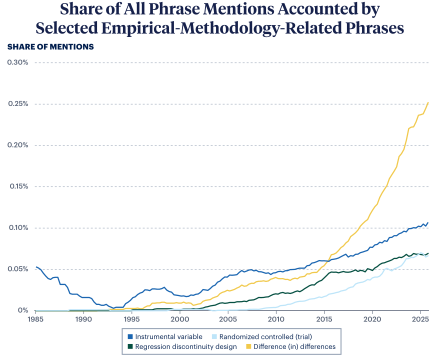
Second, in terms of shifts in empirical methods, phrases related to the "credibility revolution" have exploded. These phrases include "instrumental variables," "difference in differences," "regression discontinuity," and "randomized controlled trials." Among these, "instrumental variables" entered earlier and has grown more slowly in recent years. Other phrases entered later and have grown faster.
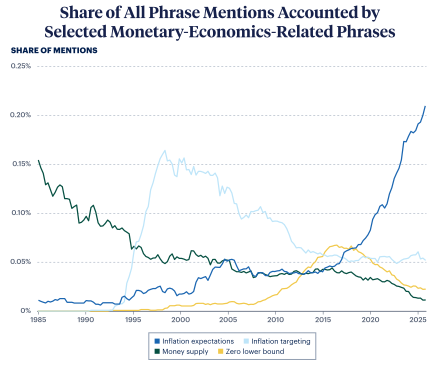
Third, over the last four decades monetary theory has increasingly focused on "inflation expectations," with considerations of the "money supply" on a steep downward trend. "Inflation targeting" and the "zero lower bound" peaked in the late 1990s and mid-2010s, respectively. More broadly, economists have increasingly featured multiple types of households ("heterogeneous agent") and firms ("heterogeneous firms") in their macroeconomic models.
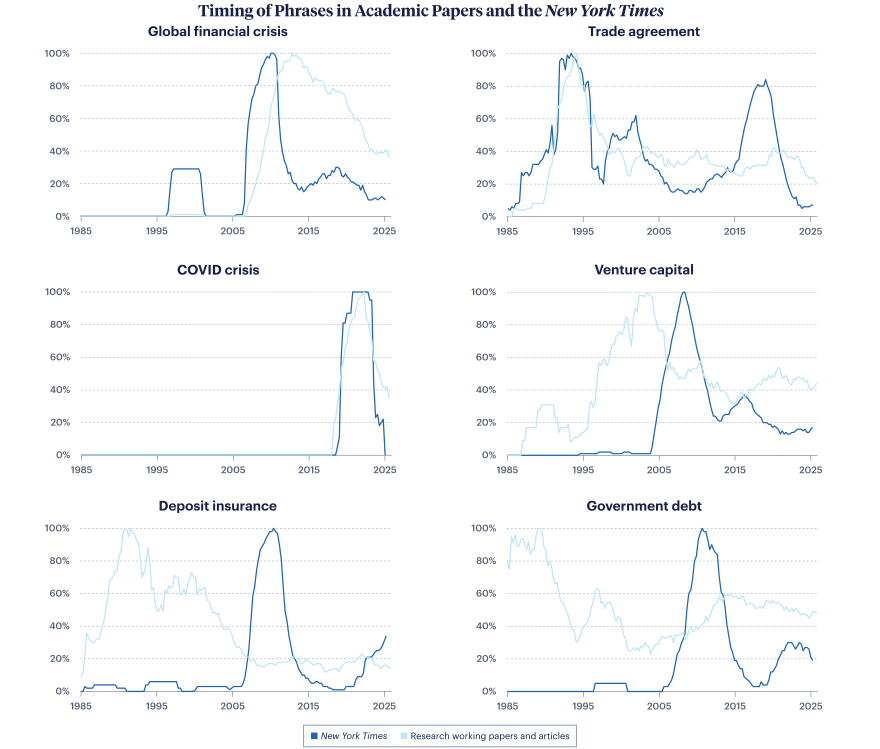
Fourth, when I compare the timing of mentions of a handful of policy-related phrases in the academic literature with those in the New York Times, I find important cases in which academic research lagged real-world events, but also many cases in which research appeared soon after real-world events. Moreover, because many policy debates are evergreen, the popularity of many phrases indicates that the academic literature has often preceded policy debates.
Fifth, to better understand the causes of these trends, I test whether professional incentives reward the application of new methods and the study of new policy topics. I find that papers applying "cutting-edge" language tend to be cited more but are less likely to be published in top economics journals.
This article focuses on trends in the phrases economists have used since 1985 in their paper titles and abstracts. It builds on historical and sociological accounts of economics as a field and a profession. Definitions of economics have themselves changed over time, from Jean-Baptiste Say's definition of a study of "the production, distribution, and consumption of wealth"5 to more recent definitions focusing on how people and societies choose how to allocate scarce resources.6 Beyond the change in definition, beginning in the first half of the 20th century economics has also become more professionalized, with rising credentialism and institutional authority.7 In the decades following World War II, economists increasingly relied on abstract, mathematical models and econometric techniques. Economics has experienced several additional shifts since the 1960s: The boundaries of economics have expanded, bringing the study of crime, fertility, and discrimination into the core of the discipline;8 macroeconomics has comprised a decreasing share of published economic research;9 and — even more recently — empirical work has drawn on advances in computing power and ever-larger data sets10 and become more focused on identifying causal relationships.11
Methods and Data
The primary data set for this article comprises metadata (title, abstract, year, and outlet) for 281,102 working papers and journal articles circulated between 1985 and 2025.12 These papers and articles come from 53 journals13 and 25 working paper series,14 with metadata compiled by the Research Papers in Economics (RePEc) project. The three largest data sources within the sample are the MPRA (53,957 working papers), the NBER (32,748 working papers), and the IZA (18,136 working papers).
For each of the 280,000 working papers and articles, I recorded mentions of two- and three-word phrases from the text of their abstracts and titles.15 To keep the analysis focused on commonly used phrases, I searched for those phrases that had appeared at least 250 times since 1985.16 This threshold yields 5,107 phrases from my sample. The most frequently occurring phrases include "monetary policy" (appearing 23,236 times), "exchange rate" (20,437 times), "labor market" (19,556 times), "long run" (18,298 times), and "economic growth" (17,336 times). At the other end of the spectrum, phrases appearing exactly 250 times include "bank profitability," "gcc countries," "public insurance," "uncovered interest parity," "debt reduction," "housing demand," and "probability weighting."
The Evolution of Economic Language
I studied changes in language in economic research along three dimensions: policy topics, empirical methods, and theoretical frameworks. These dimensions capture how economists respond to real-world events, how they conduct research, and how they think about the economy. For each dimension, I characterized the trajectory of four illustrative phrases. I then analyzed 50 phrases more representative of each of the three categories.
What Economists Study
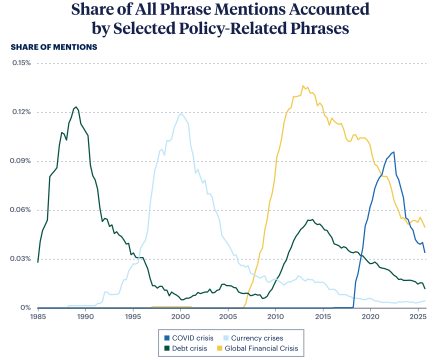
I began by analyzing the prevalence of four phrases: the "global financial crisis," the "COVID crisis," "currency crises," and the "debt crisis" (Figure 1). Each phrase corresponds to a major economic event that motivated a substantial literature.
Figure 1
Data Source: RePEc
Notes: Each data series is smoothed, with plotted values for year y and quarter q representing the average over the surrounding two years.
For each phrase and each quarter in the sample, I computed the share of mentions among all phrases mentioned in that quarter. (To reduce noise, I used a four-year moving average to smooth each series.) For instance, in the first quarter of 2012, there were 57 mentions of "global financial crisis" out of 23,278 mentions of the different phrases I searched for. The unsmoothed value for this phrase was 0.25 percent for the first quarter of 2012; this was the peak quarter for this term. Averaging over all quarters between the first quarter of 2010 and the first quarter of 2014, the smoothed share plotted for the first quarter of 2012 is 0.13 percent.
I then measured how quickly each phrase rose and fell in popularity. I define the adoption half-life as the number of years it took for a phrase's smoothed usage to grow from half of its eventual peak to the peak itself; I define the descent half-life as the number of years it took for usage to decline from the peak back down to half of the peak. For instance, it took three-and-a-quarter years (this is the adoption half-life) for mentions of the "global financial crisis" to go from 0.07 percent (in the third quarter of 2009) to its fourth-quarter 2012 peak, and another nine-and-a-quarter years (this is the descent half-life) to go back down to 0.07 percent.
The Global Financial Crisis (GFC) has been an important topic of study since 2009. Within this literature, the first wave of papers focused on the spillovers from the United States to other countries and on policy responses that were implemented at the height of the financial crisis. Later work assessed the longer-run impact of the GFC.
Emerging market currencies experienced sharp devaluations in the 1990s: Mexico in 1994, Thailand in 1997, Russia in 1998, and Brazil in 1999. This motivated a literature on "currency crises" near the turn of the century. Many of these articles examined whether currency crises could be "self-fulfilling," and how monetary policy and currency crises interact.
The COVID-19 pandemic spurred an intense burst of research in the early 2020s, peaking in the second quarter of 2022. Compared with research on other crises, the literature on the pandemic was exceptionally quick to emerge and fade, with nearly all research circulated within the first three years of the pandemic.
Unlike other phrases, "debt crisis" peaked twice — once in the late 1980s and again in the early 2010s. The early 1990s literature on debt crises was primarily motivated by the 1980s debt crises in Latin America. High public debt in Portugal, Ireland, Italy, Greece, and Spain in the aftermath of the GFC revived interest in debt crises in the early 2010s.
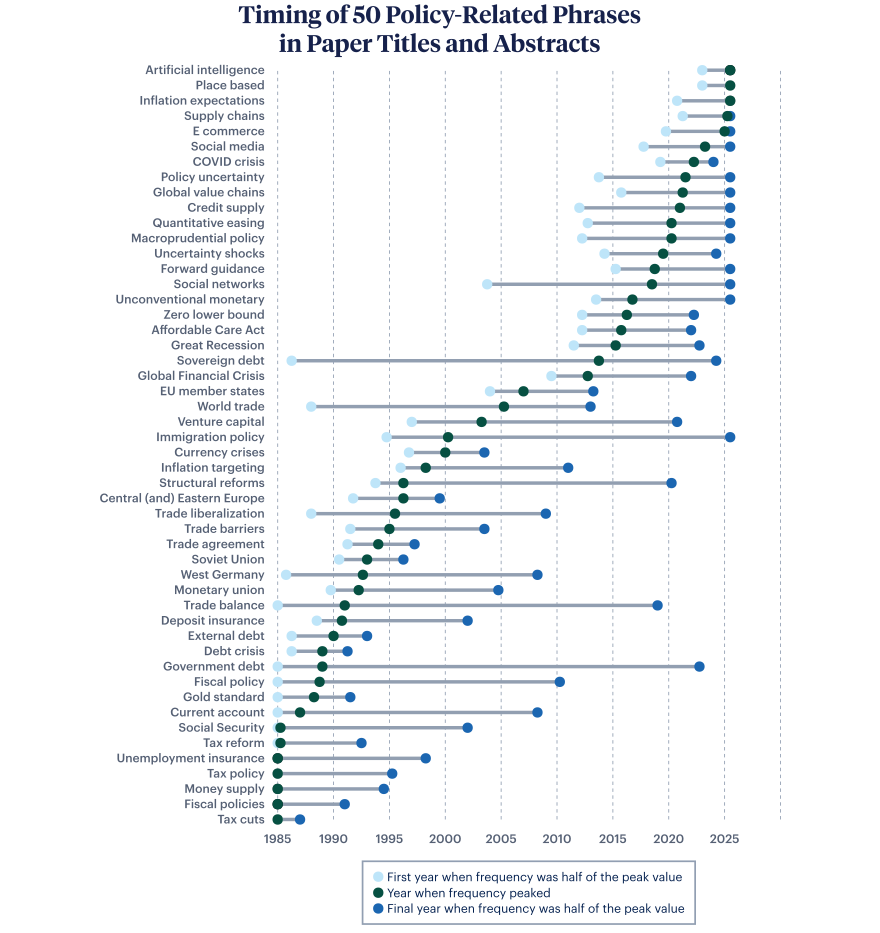
When I expanded the scope to include 50 policy-related phrases, I found that many of the policies studied toward the beginning of the sample focused on international trade ("trade liberalization," "external debt," "trade barriers," and "current account") or fiscal policies ("fiscal policy/policies," "tax reform," "tax policy," and "tax cuts") (Figure 2). After the fall of the Soviet Union, researchers studied the transition from communism to capitalism in the Soviet Union and Central and Eastern Europe, as well as the reunification of Germany. The GFC and associated recession prompted the study of "sovereign debt," the "zero lower bound," "unconventional monetary policy," "forward guidance," and "quantitative easing." The latter four phrases are all associated with changes in monetary policy brought about by the GFC. Finally, policy debates from the 2020s include the assessment of place-based policies, the potential impact of artificial intelligence, and the causes and consequences of pandemic-era supply chain disruptions.
Figure 2
Data Source: RePEc
Notes: Each phrase is presented in a separate row. For the three-word phrase "Central Eastern Europe," my initial parsing removed the stop word "and." In this case, I added it back into the figure label.
For many policy phrases, interest followed the news cycle. Interest spiked after an important event but then faded after subsequent urgent events or once the policy debate had moved elsewhere. By contrast, topics such as "debt crisis" reappeared because the underlying problem recurred in new contexts or with new institutional features.
How Economists Work with Data
Next, I mapped the frequency of four empirical methods: "instrumental variable," "regression discontinuity design," "difference (in) differences," and "randomized controlled (trial)" (Figure 3). These methods, which were first popularized in the late 1990s and then used with increasing frequency up to the late 2010s, are part of a broader shift in economics — often referred to as the "credibility revolution"17 — toward research designs offering more credible evidence of cause and effect.18 They were introduced in response to contemporaneous concerns, up to the 1980s, that empirical research could not provide reliable conclusions on the effectiveness and impact of different economic policies.19 The credibility revolution introduced new tools to make those conclusions possible. Compared with the other three methods, "instrumental variable" was introduced earlier, with slower growth in mentions in the 2000s and 2010s.
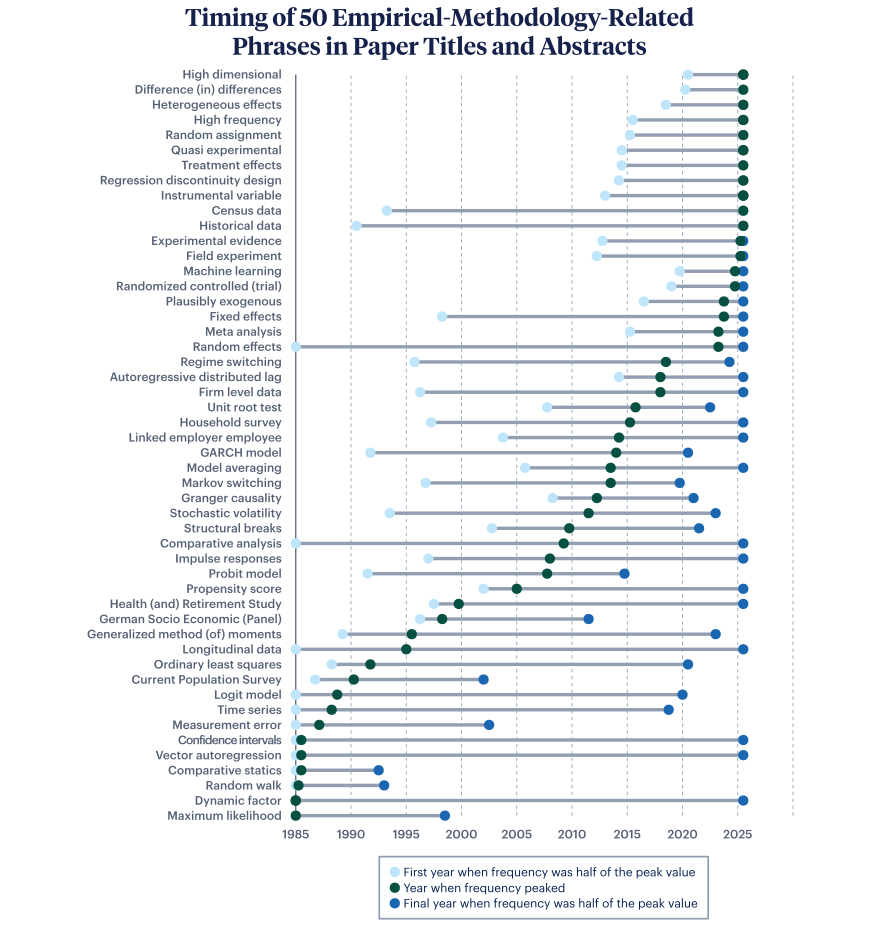
When I broadened the scope to 50 phrases related to the empirical tools developed by economists and the data sets they employ in their research, I found that methods specific to time series were introduced relatively early and grew much more slowly (Figure 4). These methods include "GARCH model," "unit root test," "structural breaks," and "stochastic volatility."
Compared with the policy-related phrases discussed above, empirical methods were (on average) adopted much more slowly. Whereas the average policy phrase took only 4.6 years to go from 50 percent to 100 percent of its peak, the average empirical-methodology term took 10.4 years. Phrases that took exceptionally long to go from 50 percent to 100 percent of their peak include those describing what types of data are used — "firm level data," "historical data," and "census data" — as well as phrases such as "comparative analysis," "probit model," and "random effects." Overall, I find that, compared with policy concepts, empirical tools are adopted much more gradually but tend to persist in the literature once adopted.
Figure 3
Data Source: RePEc
Notes: Each data series is smoothed, with plotted values representing the average over the surrounding two years. For the two-word phrase "difference differences," my initial parsing removed the stop word "in." In this case, I added it back into the figure label. I append "trial" to "randomized controlled" to reflect how these words are typically used together.
Figure 4
Data Source: RePEc
Notes: Each phrase is presented in a separate row. I append "trial" to "randomized controlled" and "Panel" to "German Socio Economic" to reflect how these words are typically used together. For the phrases "difference differences," "health retirement study," and "generalized method moments," my initial parsing removed the stop words "in," "and," and "of," respectively. In these cases, I added them back into the figure labels.
How Economists Think
Finally, I studied the rise and fall of different theoretical concepts in economic research. Because monetary theory is so important for the Federal Reserve, I first looked at phrases related to monetary economics. Specifically, I examined the different topics that monetary policymakers and researchers have grappled with over the last several decades (Figure 5). In the late 1970s and early 1980s, an important policy tool for the Federal Reserve was control of the money supply.20 Accordingly, "money supply" was mentioned relatively frequently early on. Central banks' adoption of inflation targeting motivated an ensuing literature in the 1990s and early 2000s. Papers on the "zero lower bound" and "inflation expectations" picked up in the 2010s and 2020s, respectively.
Figure 5
Data Source: RePEc
Notes: Each data series is smoothed, with plotted values for year y and quarter q representing the average over the surrounding two years.
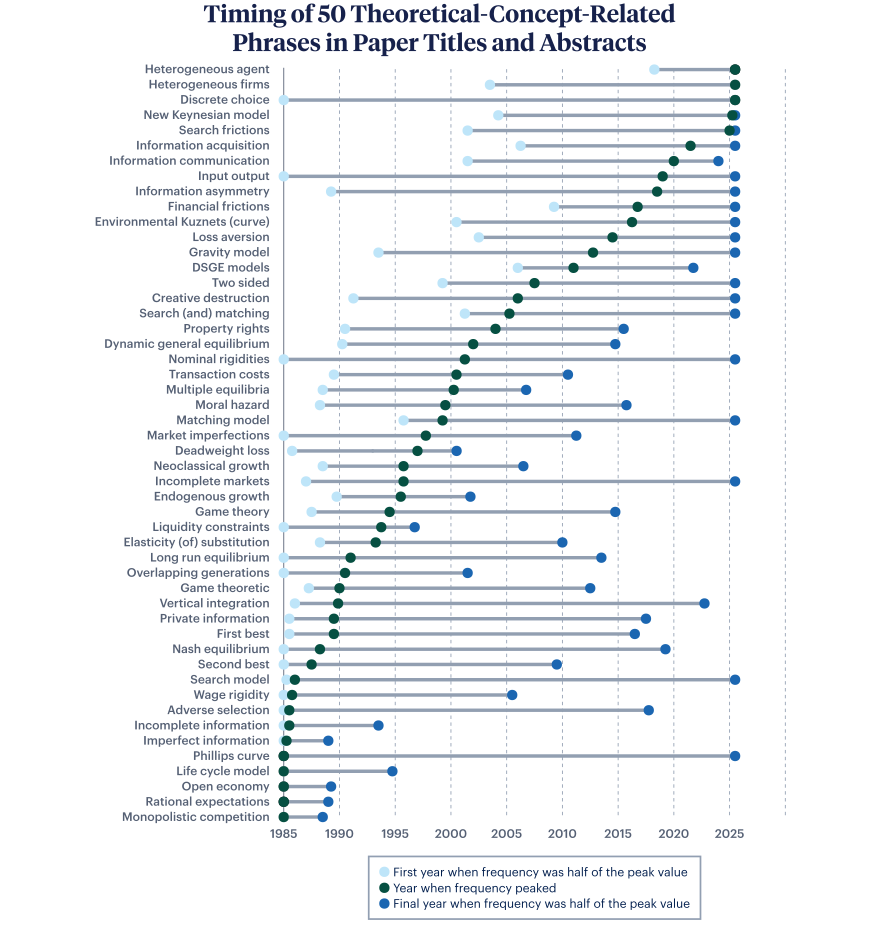
I then broadened the scope by showing the evolution of 50 phrases related to different theoretical concepts in economic research (Figure 6). The last 10 to 15 years have witnessed the increasing incorporation of frictions ("financial frictions," "search frictions," and "information asymmetry") and multiple types of households ("heterogeneous agent") into macroeconomic models.
I found that theoretical language — in monetary economics in particular and in economics more broadly — evolved gradually and incrementally. For the 50 phrases, the average descent half-life was 14.1 years, compared with 10.8 years for empirical-method phrases (Figure 4) and 8.8 years for policy phrases (Figure 2). Even phrases that "peaked" in the 1980s or 1990s (such as "adverse selection," "private information," and "incomplete markets") continued to be mentioned well into the 2010s. Once concepts were introduced, they rarely faded from use.
How Timely Is Economic Research?
In this section, I consider the timeliness of economic research. With the intuition that news media should record events related to the economy as they happen, I compared the timing of policy-related phrases in economic research with those in the New York Times. For each phrase, I computed the frequency (mentions per article) in the New York Times' Business, Economics, Politics, World, and International sections.
Among these, I plotted the timing of six policy-related phrases that span different policy areas and are representative of broader differences in the relative timing of academic research and real-world policy debates (Figure 7). Mentions of the "global financial crisis" peaked in the second quarter of 2010 in the New York Times and in the fourth quarter of 2012 in research articles and working papers. This gap of two-and-a-half years is larger than that for "trade agreement" (a three-quarter gap) and for "COVID crisis" (a gap of two quarters). For other policy-related phrases, academic research may even precede media interest. The literature on "venture capital" is a good example. With interest peaking in the late 1990s and early 2000s, financial and public economists studied how venture capital contracts are written, how venture capital affects entrepreneurship, and how legal and tax policy influences the prevalence of venture capital. By contrast, the share of New York Times articles mentioning venture capital peaked in the late 2000s, a period when venture capital investment sharply fell. The "venture capital" literature is far from unique. Many other academic literatures — including those related to "deposit insurance" and "government debt" — preceded peak interest in the New York Times.
Is Cutting-Edge Research More Influential?
Professional incentives often reward continuity more than novelty. Is this true for economics? To find out, I ranked papers by how often they used newer phrases compared with their peers published in the same year. Papers that rely on older language I call "traditional," whereas those that lean more on newer phrases I label "cutting-edge."21 For each article, I compared this ranking to two measures of influence: the number of citations it has received and whether it was published in a "top" journal.22
Figure 6
Data Source: RePEc
Notes: Each phrase is presented in a separate row. In some instances, my initial parsing removed stop words. In these cases, I added them back, in parentheses. I append "curve" to "environmental Kuznets" to reflect how these words are typically used together. For the phrases "search matching" and "elasticity substitution," my initial parsing removed the stop words "and" and "of," respectively. In these cases, I added them back into the figure labels.
Figure 7
Data Source: RePEc and the New York Times
Notes: Each data series is smoothed, with plotted values for year y and quarter q representing the average over the surrounding two years. The research series measure each phrase’s share of all selected phrase mentions, while the New York Times series measure mentions per article. Each series is normalized to 1 in the quarter in which it reaches its maximum smoothed value.
My analysis yields two findings. Cutting-edge papers have more than double the citations relative to traditional papers published in the same year. This isn't too surprising: Papers that introduce new tools or are the first to engage with emerging policy debates are more likely to attract attention and be cited in later years. Conditional on appearing in one of the journals in my data set, and accounting for citations, cutting-edge articles were 50 percent less likely to have appeared in a top journal. Even though novelty is supposed to drive publication decisions, it seems that top journal editors are particularly conservative in their choice of papers to publish. In short, cutting-edge research gets more attention, but not necessarily from top economics journals.
Conclusion
This article illustrates the evolution in the policy topics, empirical tools, and theoretical concepts central to economics. It describes a discipline that is quick to react to crises but slow to change its core tools; employs a new suite of methodologies to identify causal relationships in economic data; and, within macroeconomics, increasingly focuses on financial and liquidity constraints and heterogeneity across households. Although there are instances in which economic research lags real-world policy debates, these are far from the norm. Papers mentioning relatively new phrases tend to be cited more but are less likely to appear in top journals. Together, these patterns depict a field that reacts swiftly to emerging policy debates — often in step with policymakers and journalists — while adopting new theoretical and empirical methodologies only gradually.
References
Angrist, Joshua D., and Jörn-Steffen Pischke. "The Credibility Revolution in Empirical Economics: How Better Research Design Is Taking the Con Out of Econometrics," Journal of Economic Perspectives, 24:2 (2010), pp. 3–30, https://doi.org/10.1257/jep.24.2.3.
Backhouse, Roger E., and Béatrice Cherrier. "The Age of the Applied Economist: The Transformation of Economics Since the 1970s," History of Political Economy, 49 Supplement (2017), pp. 1–33, https://doi.org/10.1215/00182702-4166239.
Backhouse, Roger E., and Steven G. Medema. "Retrospectives: On the Definition of Economics," Journal of Economic Perspectives, 23:1 (2009), pp. 221–233, https://doi.org/10.1257/jep.23.1.221.
Becker, Gary S. Economic Theory. New York: Alfred A. Knopf, 1971.
Caballero, Ricardo J. "Macroeconomics After the Crisis: Time to Deal with the Pretense-of-Knowledge Syndrome," Journal of Economic Perspectives, 24:4 (2010), pp. 85–102, https://doi.org/10.1257/jep.24.4.85.
Currie, Janet, Henrik Kleven, and Esmée Zwiers. "Technology and Big Data Are Changing Economics: Mining Text to Track Methods," AEA Papers and Proceedings, 110 (2020), pp. 42–48, https://doi.org/10.1257/pandp.20201058.
Fourcade, Marion. Economists and Societies: Discipline and Profession in the United States, Britain, and France, 1890s to 1990s. Princeton, NJ: Princeton University Press, 2009, https://doi.org/10.1515/9781400833139.
Fourcade, Marion. "Economics: The View from Below," Swiss Journal of Economics and Statistics, 154:5 (2018), pp. 1–9, https://doi.org/10.1186/s41937-017-0019-2.
Fourcade, Marion, Étienne Ollion, and Yann Algan. "The Superiority of Economists," Journal of Economic Perspectives, 29:1 (2015), pp. 89–114, https://doi.org/10.1257/jep.29.1.89.
Goldsmith-Pinkham, Paul. "Tracking the Credibility Revolution Across Fields" (2024), https://doi.org/10.48550/arXiv.2405.20604.
Heckman, James J., Edward P. Lazear, and Kevin M. Murphy. "Gary Becker Remembered," Journal of Political Economy, 126:S1 (2018), pp. S1–S6, https://doi.org/10.1086/698751.
IDEAS. "RePEc: Getting the Metadata" (n.d.), https://ideas.repec.org/getdata.html.
Kosnik, Lea-Rachel. "What Have Economists Been Doing for the Last 50 Years? A Text Analysis of Published Academic Research from 1960–2010," Economics, 9:1 (2015), pp. 1–38, https://doi.org/10.5018/economics-ejournal.ja.2015-13.
Leamer, Edward E. "Let's Take the 'Con' Out of Econometrics," American Economic Review, 73:1 (1983), pp. 31–43.
Mandelman, Federico, and Brent Meyer. "Lessons from the Past: Can the 1970s Help Inform the Future Path of Monetary Policy?" Federal Reserve Bank of Atlanta Policy Hub: Macroblog, August 31, 2022, https://www.atlantafed.org/research-and-data/publications/policy-hub-macroblog/2022/08/31/can-1970s-help-inform-future-path-of-monetary-policy.
Nobel Prize. "Robert C. Merton: Biographical" (1997), https://www.nobelprize.org/prizes/economic-sciences/1997/merton/biographical/.
Nobel Prize. "Alvin E. Roth: Biographical" (2012), https://www.nobelprize.org/prizes/economic-sciences/2012/roth/biographical/.
Nobel Prize. "Paul R. Milgrom: Biographical" (2020), https://www.nobelprize.org/prizes/economic-sciences/2020/milgrom/biographical/.
Samuelson, Paul A. Economics, 10th ed. New York: McGraw-Hill, 1976. (Statistical updating by Peter Temin.)
Say, Jean-Baptiste. Traité d'économie politique, 1st ed. Paris, 1803.
- The views expressed in this article are solely those of the author and do not necessarily reflect the views of the Federal Reserve Bank of Philadelphia or the Federal Reserve System.
- See Nobel Prize (1997).
- See Nobel Prize (2012).
- See Nobel Prize (2020).
- As argued by Caballero (2010), for example.
- Say (1803).
- Samuelson (1976) and Becker (1971). These quotes are all drawn from Backhouse and Medema's (2009) history of the definition of "economics."
- See Fourcade (2009, 2018) and Fourcade, Ollion, and Algan (2015).
- See Heckman et al. (2018).
- See Kosnik (2015).
- See Backhouse and Cherrier (2017).
- See Angrist and Pischke (2010).
- The number of papers circulated per year has been on an upward trend, increasing from around 1,100 in the late 1980s to roughly 12,400 in the early 2020s. For this reason, some of the statistics from earlier in the sample will be subject to greater year-to-year variability. I do not deduplicate papers appearing in multiple outlets. For example, a paper appearing first as a working paper and then as a published journal article — or a paper appearing in two separate working paper series — will appear twice in the data set. Also, because journals record the year of publication rather than the initial circulation, the same paper will typically be assigned a later year when it appears in a journal than when it first appeared as a working paper. See IDEAS (n.d.) for a description of how to download the data. I downloaded the data on September 22, 2025.
- The 53 journals include AEJ: Applied Economics; AEJ: Macroeconomics; AEJ: Microeconomics; AEJ: Policy; American Economic Review; American Economic Review: Insights; AEA: Papers & Proceedings; Econometrica; Economic Inquiry; Economic Journal; Economics Letters; Energy Economics; European Economic Review; Games and Economic Behavior; International Journal of Industrial Organization; International Economic Review; Journal of Accounting and Economics; Journal of Banking & Finance; Journal of Business & Economic Statistics; Journal of Development Economics; Journal of Economic Behavior & Organization; Journal of Economic Dynamics and Control; Journal of Economic Growth; Journal of Economic Literature; Journal of Economic Perspectives; Journal of Economic Theory; Journal of Finance; Journal of Financial and Quantitative Analysis; Journal of Financial Economics; Journal of Health Economics; Journal of Human Capital; Journal of Human Resources; Journal of Industrial Economics; Journal of International Economics; Journal of International Money and Finance; Journal of Labor Economics; Journal of Monetary Economics; Journal of Money, Credit and Banking; Journal of Political Economy; Journal of Population Economics; Journal of Public Economics; Journal of the European Economic Association; Journal of Urban Economics; Labour Economics; Oxford Economic Papers; Quarterly Journal of Economics; RAND Journal of Economics; Research Policy; Review of Economic Studies; Review of Economics and Statistics; Review of Financial Studies; Theoretical Economics; and World Development.
- The 25 working paper series include those from the Centre for Economic Performance at the London School of Economics; CESifo; the Center for Economic and Policy Research; the European Central Bank; each of the 12 regional Federal Reserve Banks; the Federal Reserve Board; the Institute for Fiscal Studies; the Institute for Labor Economics (IZA); the International Monetary Fund; the Munich Personal RePEc Archive (MPRA); the National Bureau of Economic Research (NBER); Princeton University's Industrial Relations Section; the U.S. Census Bureau; and the World Bank.
- Phrase-mention counts provide a simple proxy for what each paper is about. These counts are easy to compute and interpret but are inevitably incomplete descriptors of papers' content.
- Before my search, I removed stop words from titles and abstracts. After recording the two- and three-word phrases, I dropped those that are not informative about the content of the research article.
- Angrist and Pischke (2010).
- Currie et al. (2020) were the first to comprehensively document the rise of phrases related to the credibility revolution in the text of economics articles. Going one step further, Goldsmith-Pinkham (2024) compares mentions of these phrases across different subfields of economics. For a narrower set of journals than in this Economic Insights article, Goldsmith-Pinkham has developed an online dashboard of the prevalence of phrases used in economic research; see https://paulgp.com/econlit-pipeline/index.html.
- See Leamer (1983).
- See Mandelman and Meyer (2022).
- I provide an explanation of these calculations in the Appendix, which is available at https://www.philadelphiafed.org/-/media/FRBP/Assets/Economy/Articles/economic-insights/2026/May/ei2026-may-appendix.pdf. Because this section restricts attention to published articles, statements about influence are conditional on publication.
- These top journals are the American Economic Review, Econometrica, the Journal of Political Economy, the Quarterly Journal of Economics, and the Review of Economic Studies.