


Stablecoins are digital assets designed to maintain a stable value. Unlike volatile cryptocurrencies, they aim to combine the programmability of blockchains with the predictability of traditional money.1 They represent a new wave of privately issued money, much like the private banknotes issued by unregulated banks during the Free Banking era of the 1830s–1860s, when the United States had no central bank or federal currency. Just as that era saw the proliferation of dozens of regional currencies, the cryptocurrency era has seen the creation of more than one hundred stablecoins.2
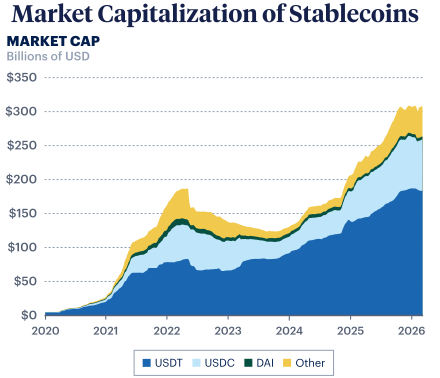
Stablecoins are one of the fastest-growing asset classes in decentralized finance (DeFi). The volume of stablecoins in circulation has skyrocketed since the "DeFi summer" of 2021, growing over tenfold from $25 billion to nearly $300 billion (Figure 1). Today, stablecoin transaction volumes rival those of major payment processors such as Visa and Mastercard.3 Although a wide variety of stablecoins are in circulation, the market has usually been dominated by a small number of dollar-denominated stablecoins.
Figure 1
Source: DefiLlama (2026) and author's calculations
The motivation to create stablecoins has changed as the asset class has matured. Stablecoins originally emerged as a safe medium of exchange for cryptocurrency traders. They were a "blockchain-native" asset for traders who wanted to keep their funds on the blockchain while avoiding undesired fluctuations in the value of a cryptocurrency. Once they exploded in popularity, stablecoins began to play a role in the real economy as well, gaining use as a payment instrument for international remittances and business-to-business (B2B) transactions. In these applications, stablecoins allow users to circumvent some of the frictions in bank transactions, such as exchange fees or long settlement times. Stablecoins have also attracted interest as a hedge against local inflation for investors in both emerging and middle-income countries such as Nigeria and Turkey.
The future of stablecoins remains contested because of their changing role in the economy. Some expect them to be broadly adopted for international transactions, which would strengthen the dollar globally because almost all stablecoins are dollar-denominated. U.S. Secretary of the Treasury Scott Bessent agrees, saying, "[Stablecoins] will buttress the dollar's status as the global reserve currency, expand access to the dollar economy for billions across the globe, and lead to a surge in demand for U.S. [Treasury bills]."4
Others are pessimistic, arguing that stablecoins are just as unstable as previous private monies. The Free Banking era, for example, was characterized by currencies that frequently traded below par and by widespread bank failures. "Stablecoin issuers are unregulated banks," says Yale University professor of management and finance Gary Gorton, an expert on money and banking. "And the problems underlying circulating private money do not change — namely, private money is a subpar (literally) medium of exchange and its issuers are subject to destabilizing bank runs."5
Despite these disagreements, understanding their history and the current regulatory landscape can help us answer important questions about the future of stablecoins. Will they be a medium of exchange for everyday transactions, or will they serve primarily as a store of value? Will they complement the existing dollar payment system, or will they remain confined to the cryptocurrency ecosystem? Answering these questions is key to understanding whether this latest form of private money will succeed where previous private monies have failed.
How Stablecoins Work
Early in their development, three models of stablecoins emerged, differing in their backing and risks. Under the simplest model, a reserve-backed stablecoin, the issuer holds $1 of reserves for each token issued. Reserves are typically short-maturity dollar assets, such as bank deposits, commercial paper, or Treasury bills (T-bills). The stablecoin's value is pegged via arbitrage logic. That is, investors can typically redeem their stablecoins in exchange for reserves, giving them confidence that the price will not fall below $1. Conversely, if the price rises above $1, then authorized participants (usually large financial institutions) can receive a newly minted token for each $1 of reserves they deposit.
Although this pegging mechanism sounds simple and robust, investors face risks. It can be hard to ascertain the quality of an issuer's reserves, especially when the issuer's balance sheet is not frequently audited. Some types of reserves, such as T-bills, are safer and more liquid than others, such as commercial paper, which can become illiquid during episodes of financial stress. Issuers may also suspend convertibility: If an issuer runs into financial trouble, it might refuse to let customers redeem their stablecoins.
Another model is a crypto-backed stablecoin, which is (over)collateralized by other cryptocurrencies rather than dollar assets. For example, Maker, the issuer of the Dai stablecoin, allows users to borrow $100 of newly minted Dai by depositing enough of another currency, such as $150 of Ether. The collateral ratio is the value of Ether the user must deposit per dollar of Dai borrowed (1.5 in this example). The collateral is locked in a smart contract called a vault, which is effectively a digital pawn shop. If Dai falls below $1, the user can return the borrowed Dai to get the collateral back. On the other hand, if the value of the user's Ether deposit falls below the required collateral ratio, the deposit is automatically liquidated to repay the loan.
There are risks here, too. Overcollateralization does not guarantee that the peg will hold. A large market move could cause the value of the collateral to fall below the value of issued stablecoins, forcing the price below $1. The prospect of a "liquidation spiral" exacerbates this risk. For instance, a fall in Ether's price could cause a wave of liquidations for holders of Dai. These forced sales of Ether would drive the price down even further, triggering more liquidations, and so on.
The most speculative model is an algorithmic stablecoin, which dispenses with formal backing altogether. Under this model, the issuer pegs the price by adjusting the stablecoin supply in response to changes in demand. This is usually accomplished with a "two-token" model: In addition to the stablecoin, the issuer creates a cryptocurrency whose price may fluctuate. When the stablecoin's price falls below $1, investors can exchange each of their stablecoins for $1 of newly minted cryptocurrency (and vice versa when the price rises above $1). The supply of stablecoins then rises and falls with demand to maintain the peg.
Algorithmic stablecoins face a clear risk. Unlike a reserve-backed stablecoin, there is no guarantee of the volatile cryptocurrency's value. If investors lose confidence in the cryptocurrency, then nothing remains to back the stablecoin. Once the price of the cryptocurrency falls to zero, the issuer has no way to meet investors' demand for redemptions. As we will see, this risk is not purely theoretical — it brought down Terra, the most popular algorithmic stablecoin to date.
Runs on Stablecoins
The history of runs on stablecoins provides some guidance about which model is likely to prevail in the long run. To begin with, the run on Terra proved the fragility of the algorithmic model. The Terra stablecoin used the two-token model. Its issuer, Terraform Labs, created a stablecoin (UST) and a cryptocurrency (LUNA). Terraform Labs could create or destroy LUNA as needed to accommodate investor redemptions of UST.
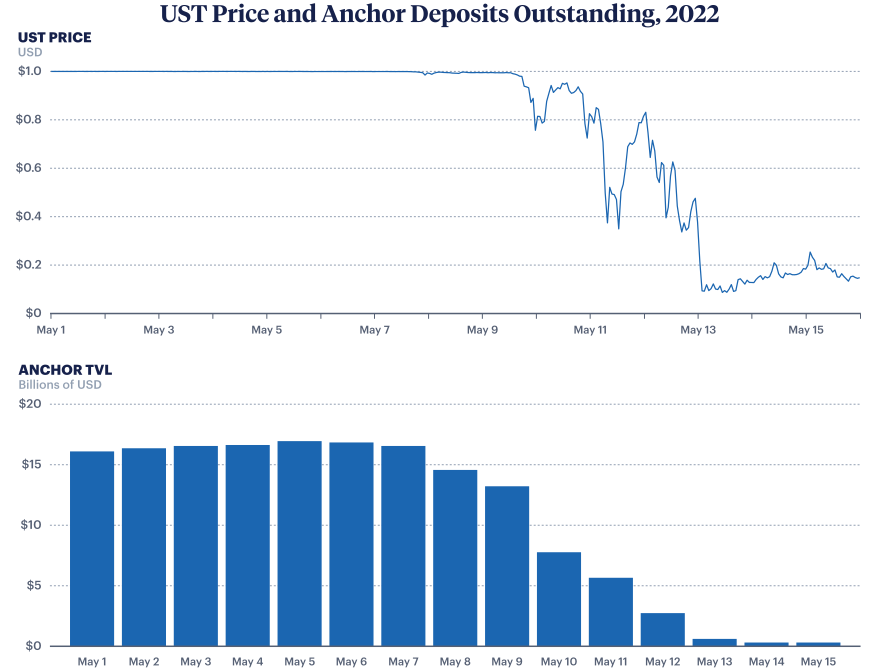
The value of UST was sustained by circular logic. LUNA derived its value from transaction fees paid by UST investors. Holders of LUNA could "stake" their tokens in a smart contract that would pay them a fraction of those fees. As UST grew more popular, so did the rewards for LUNA investors. Terraform Labs propped up UST demand by offering a 20 percent annual percentage yield interest rate on UST deposits (via an app called Anchor). These interest payments were financed by Terraform Labs' seigniorage revenues, which in turn came from growth in UST demand.6
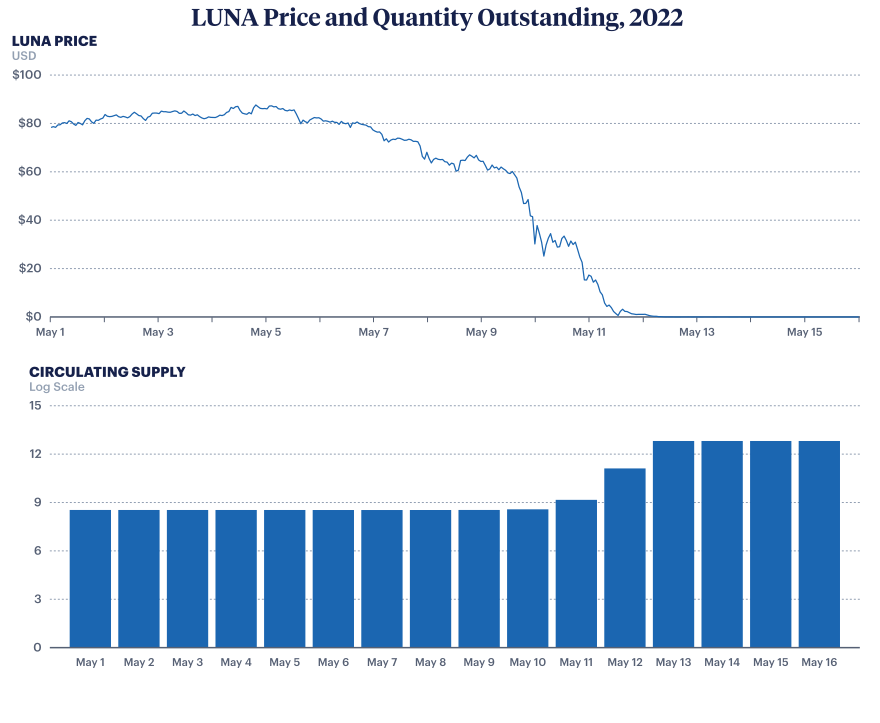
In early 2022, the "yield reserve" used to pay Anchor depositors was strained by ballooning deposits. Terraform Labs announced that it would decrease Anchor's interest rate, triggering a crisis in confidence. Escalating withdrawals from Anchor reduced UST transaction demand and undermined LUNA's backing. Uncertainty about LUNA's value caused a run on the Terra ecosystem. Investors rushed to redeem their UST before others could do so. The supply of LUNA exploded from 342 million to 6.5 trillion tokens, and both UST (Figure 2) and LUNA (Figure 3) became essentially worthless.
Figure 2
Sources: DefiLlama (2026) and CryptoCompare (2026)
Figure 3
Sources: CryptoCompare (2026), CoinMarketCap (2026), and author's calculations
This episode highlights a basic economic point: Algorithms alone cannot guarantee stability. Just like fiat currency, which is issued by a government, an algorithmic stablecoin is backed by investor confidence. No algorithm can guarantee stability if the value of the collateral falls to zero.
Since the Terra run, the market has switched almost entirely to the reserve-backed model. Two reserve-backed stablecoins, Tether and USD Coin (USDC), now account for over 90 percent of the market. Early in their growth, reserve-backed stablecoins held portfolios with significant exposure to the commercial paper market. There were even doubts about whether Tether was fully backed. The Commodity Futures Trading Commission found that Tether had sufficient reserves to back all of its issued tokens on only 27.6 percent of days from 2016 to 2018.7 Under pressure from investors and regulators, both Tether and USDC increased transparency and moved their portfolios toward T-bills and bank deposits.
However, even transparent reserve-backed stablecoins are vulnerable. The damage done by the collapse of Silicon Valley Bank (SVB) in 2023 was not limited to traditional financial markets. It triggered a run on USDC that spilled over into the broader stablecoin market. USDC held about 20 percent of its reserves in uninsured deposits at SVB, and the bank's failure threatened to inflict losses that would render Circle, USDC's issuer, insolvent. Investors rushed to redeem their USDC, but Circle suspended convertibility because it could not meet redemption demand. USDC then depegged, falling as low as 89 cents.
The crisis spilled over to other stablecoins via Dai's peg stabilization module (PSM), which allows investors to exchange Dai one-for-one for USDC. Investors who held USDC quickly moved to deposit it at the PSM in exchange for Dai, rapidly increasing the supply of Dai and reducing its price. Other stablecoins backed in part by Dai, such as Pax Dollar and Gemini USD, followed suit. This turmoil in the market for crypto-backed stablecoins undermined investors' confidence in that model moving forward.
The run ended when the U.S. Treasury, the Federal Reserve, and the Federal Deposit Insurance Corporation jointly announced that all SVB depositors would be made whole.8 Circle resumed redemptions and the price of USDC returned to $1. Ultimately, even USDC — a transparent stablecoin holding high-quality reserves — relied on a government guarantee for its survival.
The Future of Stablecoins
In light of the dominance of the reserve-backed model, even in the wake of the run on USDC, there are three likely scenarios for the development of stablecoins. They could become a popular medium of exchange for everyday transactions and cross-border remittances. They could serve as a store of value, enabling international investors to access the dollar without a U.S. bank account. Or they could remain a blockchain-native asset used primarily to trade cryptocurrency. Developments in cryptocurrency technology, international financial markets, and the regulatory environment will determine stablecoins' future path.
Although stablecoins are gaining use as a payment instrument, the vast majority of stablecoin transactions are still related to cryptocurrency trading. In 2024, almost 88 percent of stablecoin transactions were on decentralized finance platforms.9 Of this fraction, a large share was executed automatically by "smart contract" code because many automated financial contracts use stablecoins as the medium of exchange. Of the remaining transactions, only 5 percent were linked to payments, including B2B (Figure 4). Despite continued stablecoin growth in 2025, the situation for payments has not changed much. Today, retail payments account for only 0.3 percent of nonautomated transaction volume.10
Figure 4
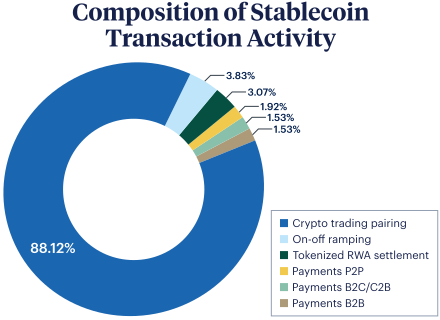
Source: Jhanji et al. (2025)
Stablecoins play a more significant role in the real economy of some high-inflation countries. For example, after years of high double-digit inflation, about half of Turkey's adult population has invested in cryptocurrencies.11 In 2024, Turkish investors' stablecoin purchases totaled more than 4 percent of gross domestic product, higher than in any other country.12 Similarly, a sharp depreciation of the naira spurred stablecoin adoption in Nigeria, primarily as a store of value but also as a means of payment.13
The GENIUS Act, a new stablecoin law passed in the United States, will influence the future of stablecoins. The law regulates stablecoins similarly to how the law regulates other payment instruments, treating them like digital cash. It requires stablecoins to be fully backed by short-term dollar reserves such as T-bills or bank deposits, and it limits issuance to permitted stablecoin issuers who must comply with anti–money laundering and sanctions laws. Importantly, the law also prohibits stablecoins from paying interest.
Overall, this regulatory treatment pushes stablecoins toward a role as a medium of exchange rather than as a store of value, and stablecoins could begin to play a major role in settlements for regulated institutions. Following passage of the GENIUS Act in 2025, a survey by EY-Parthenon, the global strategy consulting arm of British services firm Ernst & Young, found that a majority of financial institutions expected to adopt stablecoins in the next year.14 Indeed, by the end of 2025, Visa had begun to allow settlement in USDC on its network, and Mastercard had expanded USDC settlement to markets beyond the United States.15
The prohibition on interest is intended to make stablecoins an unattractive savings vehicle, especially when interest rates are high. Otherwise (or so the thinking goes), stablecoins might induce a large savings outflow from the financial system.16 For institutional investors, the prohibition on interest should make wholesale bank deposits or money market funds a more attractive store of value. But for this provision to be effective, Congress would need to close the "yield loophole," which allows cryptocurrency exchanges to offer indirect interest payments. Currently, stablecoin issuers can make payments to exchanges that list their token. Exchanges then pass these payments on to investors as "rewards" for holding the stablecoin. For example, as of March 2026, Coinbase marketed 3.50 percent rewards for holding USDC. This percentage was (not coincidentally) close to the then-current rate on T-bills. Competitive pressures strongly incentivize this arrangement, so it is likely to persist as long as the loophole remains open.
Nevertheless, there may be demand from international investors even if stablecoins pay no interest. The dollar's stability and liquidity are attractive on their own, and both institutional and retail investors in high-inflation countries might value being able to access the dollar without having to set up a U.S. bank account. Stablecoins also allow investors to circumvent de facto or de jure capital controls imposed by other countries, which are often aimed at discouraging dollar investments.
Conclusion
Stablecoins are the most recent experiment in private money creation. Their future role in the economy remains to be seen, but we can learn important lessons from their history. The reserve-backed model has won decisively in the market and is being codified into law. This legal treatment aims to popularize stablecoins as a medium of exchange, for both everyday transactions and settlement, rather than as a store of value. This means that stablecoins shouldn't add to the supply of dollar assets or compete with government debt as a safe asset. The success of the reserve-backed model suggests that demand for stablecoins will instead boost demand for existing dollar assets, which in turn is likely to strengthen the dollar.
References
Barchat, Corey. "Stablecoins: The Ultimate List (23 Stablecoins to Know in 2025)," MoonPay, August 5, 2025, https://www.moonpay.com/learn/cryptocurrency/stablecoins-list.
BVNK. "Stablecoin Utility Report 2026" (2026), https://info.bvnk.com/utility.
Chainalysis. "The Chainalysis Crypto Spring Report" (2024), https://go.chainalysis.com/crypto-spring-report.html.
Circle Executive Team. "Circle's 2025 Year in Review," Circle (2025), https://www.circle.com/executiveinsights/circle-2025-year-in-review.
CoinMarketCap. "Terra Classic Price Today" (March 24, 2026), https://coinmarketcap.com/currencies/terra-luna/.
Commodity Futures Trading Commission. "CFTC Orders Tether and Bitfinex to Pay Fines Totaling $42.5 Million," Release Number 8450-21, October 15, 2021, https://www.cftc.gov/PressRoom/PressReleases/8450-21.
CryptoCompare. "USTC Historical Price" (March 24, 2026), https://www.cryptocompare.com/coins/ustc/overview.
DefiLlama. "Stablecoins by Market Cap" (March 24, 2026), https://defillama.com/stablecoins.
Du, Chuan, Ria Sonawane, and Cy Watsky. "In the Shadow of Bank Runs: Lessons from the Silicon Valley Bank Failure and Its Impact on Stablecoins," FEDS Notes, December 17, 2025, https://www.federalreserve.gov/econres/notes/feds-notes/in-the-shadow-of-bank-run-lessons-from-the-silicon-valley-bank-failure-and-its-impact-on-stablecoins-20251217.html.
EY Parthenon. "Stablecoins in Focus: Navigating the New Digital Financial Landscape," September 2025, https://www.ey.com/content/dam/ey-unified-site/ey-com/en-us/insights/financial-services/documents/cs-eyp-stablecoin-survey.pdf.
Gorton, Gary B., and Jeffery Y. Zhang. "Taming Wildcat Stablecoins," University of Chicago Law Review, 90:3 (2023), pp. 909–971, https://lawreview.uchicago.edu/print-archive/taming-wildcat-stablecoins.
Jhanji, Kunal, Kaj Burchardi, Yue Hong Zhang, et al. "Stablecoins: Five Killer Tests to Gauge Their Potential," Boston Consulting Group, May 2025, https://media-publications.bcg.com/Stablecoins-five-killer-tests-to-gauge-their-potential.pdf.
Kucoin. "Understanding Crypto Users in Turkey: More Than Half of Turkish Adults Invest in Crypto," August 31, 2023, https://www.kucoin.com/blog/more-than-half-of-Turkish-adults-invest-in-crypto.
Sheffield, Cuy. "Making Sense of Stablecoins," Visa Perspectives, July 21, 2025, https://corporate.visa.com/en/sites/visa-perspectives/trends-insights/making-sense-of-stablecoins.html.
Tokar, Dylan. "Why Banks Are on High Alert About Stablecoins," Wall Street Journal, July 18, 2025, https://www.wsj.com/finance/currencies/why-banks-are-on-high-alert-about-stablecoins-2f308aa0.
U.S. Department of the Treasury. "Statement from U.S. Secretary of the Treasury Scott Bessent on Enactment of the GENIUS Act," July 18, 2025, https://home.treasury.gov/news/press-releases/sb0197.
Visa. "Adjusted Transaction Methodology" (n.d.), https://visaonchainanalytics.com/transactions#adjusted-transaction-methodology.
- The views expressed in this article are solely those of the author and do not necessarily reflect the views of the Federal Reserve Bank of Philadelphia or the Federal Reserve System.
- A blockchain is an immutable, open-access ledger that records the ownership of cryptocurrencies and other digital assets.
- See Barchat (2025).
- See Sheffield (2025).
- U.S. Department of the Treasury (2025).
- Gorton and Zhang (2023).
- Seigniorage revenue is the profit made by a government or bank when it issues a currency; it's the difference between the face value of the currency and the cost of producing that currency.
- Commodity Futures Trading Commission (2021).
- See Du et al. (2025).
- See Jhanji et al. (2025).
- See Visa (n.d.).
- See Kucoin (2023).
- See Chainalysis (2024).
- See BVNK (2026).
- See EY Parthenon (2025).
- See Circle Executive Team (2025).
- In April 2025, the U.S. Treasury issued a report estimating that interest-bearing stablecoins could drain up to $6.6 trillion of deposits from the banking system. See Tokar (2025).