


On the first morning of the Federal Reserve Bank of Philadelphia’s 10th Annual Fintech Conference, Philadelphia Fed President and CEO Anna Paulson sat down with Mark Gould, the Federal Reserve's first-ever chief payments executive, to talk about the evolution of the payments system and the Fed's role in keeping it safe and efficient — one of the central bank’s five key functions. The discussion centered on the Fed's instant payment service, FedNow.
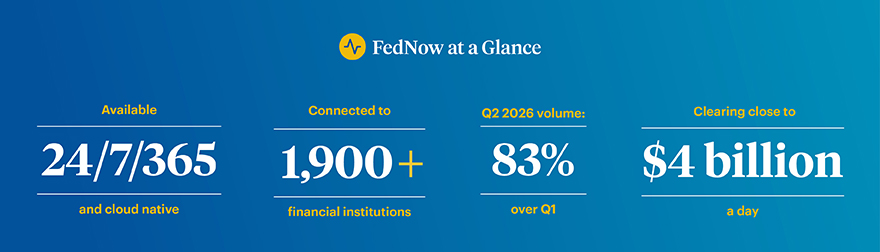
Three years after its launch, FedNow connects more than 1,900 financial institutions. Volume is growing 83 percent quarter over quarter, with daily transfers now close to $4 billion — up from $2 billion a year ago.
Watch the Fireside Chat
Five Key Takeaways from the Discussion
- Faster payments help people — especially in a crisis. President Paulson pointed to disaster relief as a powerful example of what instant payments can do, thanks to their ability to reach vulnerable families and business owners when local bank branches or ATMs may be underwater or destroyed. Gould shared a colleague's story in response: When the insurance check arrived after a flood, they found that cleanup workers were using the large envelope containing the check as a doormat. He imagined a better scenario — one with an adjuster standing in a driveway, finalizing a claim, and sending the funds instantly.
- Checks are the toughest competitor to unseat. Gould recounted a personal story of settling some accounts and asking the financial institution representative to send funds via FedNow instead of by check. Met with confusion, he ultimately gave his mailing address instead. His takeaway: Across most of the country, the real competition isn't between instant payment systems — it's still between these systems and the check.
- Innovation is outpacing the Fed’s expectations. Gould said the most compelling examples of FedNow in action are ones the Fed never anticipated. He drew a parallel to ACH, introduced 50 years ago, which now quietly powers today's app-based payment platforms. One example is earned wage access, which allows workers to get paid at the end of a shift rather than wait for payday — helping them avoid payday loans when unexpected expenses, like car repairs, hit before their next paycheck.
- Consumers — not technology — pick the winners. Gould's challenge to the industry: Make instant payments "simple, compelling, and intuitive," citing tools like cellphone video calls that require no training to use. His broader philosophy is that consumers choose the winners, and history is full of examples of superior technologies that lost out because they weren’t easy or compelling enough to use. He noted that two-thirds of FedNow payments happen outside business hours, evidence that consumer demand exists even when institutions assume otherwise.
- Agentic commerce is the next frontier. Gould said that as autonomous AI agents begin to make payments on people’s behalf, important questions will emerge, including how consumer protection laws will apply to agents and how automated micropayments will fit into today’s payment systems. He expects this shift to significantly increase the volume and complexity of U.S. payments.
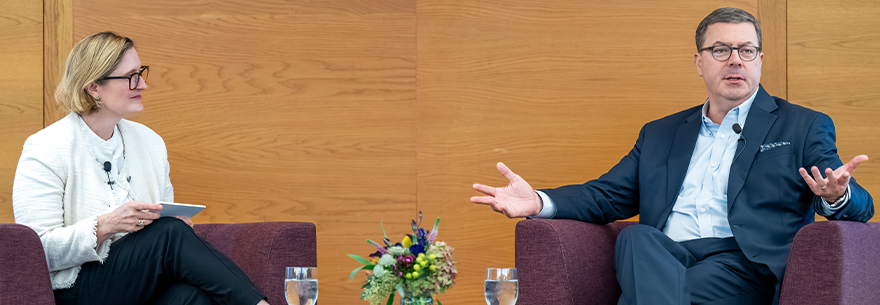
Gould, who is preparing to retire at the end of 2026 after 35 years with the Federal Reserve System, reflected on being the first chief payments executive and what it means to be a public servant. What stays with him most: Behind every one of the hundreds of millions of payments the Fed processes is a real person and, often, a life milestone — a first paycheck, a home purchase, or a tuition payment. "There's a human story ... behind every single payment we process, and that's something that I just think about every day."